
- cross-posted to:
- science_memes@mander.xyz
- cross-posted to:
- science_memes@mander.xyz
You must log in or register to comment.
Copper is actually ~25-250X leas efficient at transferring heat than a heat pipe and convection is hundreds of times more efficient than radiation at transferring heat and the fins on a heat sink would have hundreds of times more surface area for dissipating heat all that is to say this might work but it would be orders of magnitude less efficient than a standard heat sink.
Heat pipes are fucking magic and you can’t convince me otherwise
PHASE CHANGE IS LIFE
I am in my 40s and almost every day it still pops back into my head how freaking amazing it was in high school chemistry watching water in the beaker above the bunsen burner stay the same temperature while all that damn energy went into the phase change.
I also have a pond in my back yard as a hobby. The ice has pretty much all melted now, after a lot built up during the very cold weather we had a while back. But holy hell, I started up the waterfall pump while there was still ice in places but water could flow. I had big slabs of ice that were in MOVING water and did not melt for DAYS because the water was almost the same temperature. It looked wrong, but the energy just wasn’t there to do otherwise.
But without this ridiculous heatsink, we never would have gotten the most perfectly nerdy Lemmy post.
And to give it credit, I think this design wins for how much heat you can sink into the heatsink itself before you need somewhere else to put it!
It might? The only thing is that Heat pipes still transfer heat faster than copper and the air from the fan moves the heat faster than it travels through the copper, the only question is is that enough faster to make up for the speed it takes to transfer the heat from the fins into the air that is all technically radiative and thus slow but it’s only hundreds of times slower and as I already said the heat sink would be orders of magnitude faster so I doubt it.
Oh I don’t doubt that it would suck at it. It would just hold a lot of the heat within itself, eventually, lol.
That’s the joke.
I assume the joke was either how expensive or how heavy it would be.
Yeah, but won’t it also be much cheaper than machined, branded stuff?
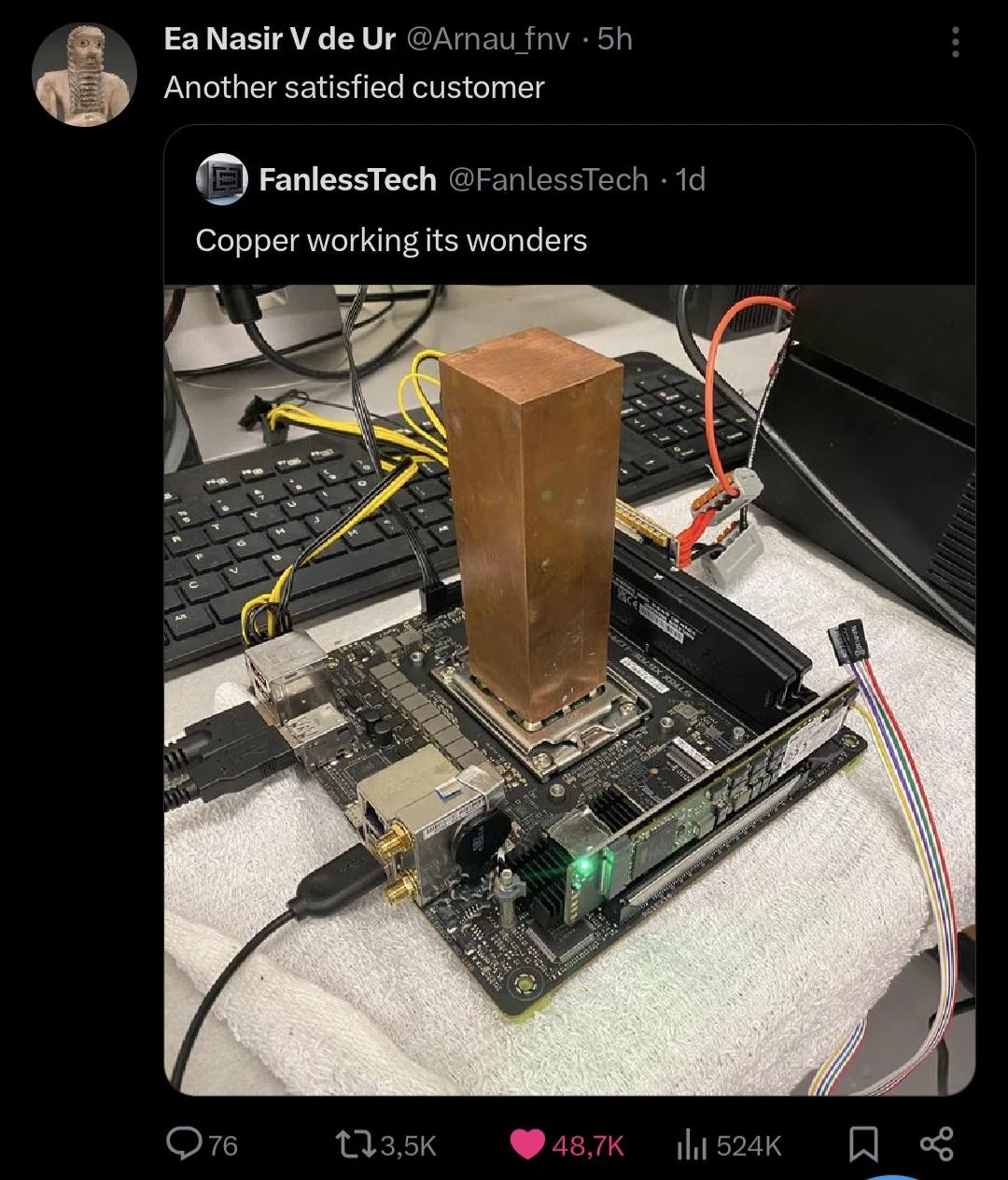
Looks nice. Why they don’t sell PCs with cooling like that? What are the downsides?
I would guess that the low surface area would lead to problems. At first it would cool very well because of the huge thermal mass, but once it reaches thermal equilibrium the cooling would be quite weak.
I’d also think moving your PC will rip your CPU right off the motherboard
The trick is not to move the PC, but rather the copper block, which just happens to have a PC attached to it.
So, you’re saying that putting blocks of copper on everything in a PC will automatically shed unnecessary parts, building a more efficient system?
Just run a solid copper block for maximum efficiency.
Wouldn’t gold be more efficient? Can’t I just fill my PC with gold doubloons? The rattling noise means it’s running.
So we need more copper?
Yes! The only way to increase the surface is to build a higher tower!
Theoretically… Hell yes!
lead to problems
We’re talking about copper, dumdum.
how long till it reaches thermal equilibrium? maybe it can endure a full load for an hour
You’re looking at about a half hour per kilogram of copper to raise it by 50 °C with 100W of heat.
Actual delta from ambient to thermal limit will typically be a little higher than that, but so is processor wattage on mid-to-high performance CPUs, so I’m happy enough with that as a ballpark estimate.
Someone else estimated that block as 4.5kg, so you’ve got something close to two and a half hours of cooling from an ambient start.
I was wondering about this too, but I’m not an engineer so I would have to look up how to calculate this
Your mom can endure a full… oh never mind.
Do you have any idea how expensive a solid block of copper that big is?
If that block is roughly 4.5cm x 4.5cm x 25cm then the volume of it is about 500cm³ which translates to 4.5kg of copper. At 11€/kg that makes about 50 euros.
Cheaper than some noctua coolers.
If this were in an enclosure, would it cause the PCB to bow over time?
Would you even notice, after buying the ram and storage?
Yes but you save on manufacturing.
Despite the cost, it’s damn heavy.
and just stupid. Cooling fins of aluminum work better.
Copper isn’t that bad. It’s not cheap exactly, but it’s probably going to cost what an expensive CPU cooler already would.
Probably around $150 worth of copper there, but you’ll have to spend about twice that to get it because it comes in a larger size you’ll have to cut down.
but a CPU cooler will work better because it is active.
Well, yeah. Even a passive CPU cooler would probably work better.
What’s a solid block of copper cost? one banana?

Weight, cost, and it’s probably not effective for the long haul. The mass of a copper ingot like that will work like a heatsink, but it has a very low surface area for the energy it can absorb. So it’ll heat up to a point that is uncomfortable for the CPU, then fail to radiate that energy out to the air effectively.
As a test-bench temporary heatsink, this is actually kind of inspired. No fans, to fussy clips, just stack a copper brick on the CPU, run some benchmarks, and then turn it all off.
My guess is that will only work until it saturates with heat. Some liquid cooling setups are also like that, where the rad isn’t capable of dissipating heat fast enough to prevent the whole thing from overheating, but it’ll work fine for a while because the loop itself can absorb a bunch of heat before it stops being able to take any more. Then they probably blame the chip maker for running too hot even with liquid cooling when their liquid cooling setup is actually less effective than the stock cooler or their case has horrible airflow and would choke any size or number of rads. But their reservoir acts as a heat buffer, so it takes 30 mins to even realize that, but they’ve already concluded it works.
And sometimes that even would be a good strategy for cases where there’s only short burst of higher heat output.
Incredibly unwieldy. Real quick estimate of volume puts that at around 1.75kg of copper, so it wouldn’t be possible to mount in a vertical PC case orientation (ie the majority of consumer PC cases) without significant (expensive) modifications to both the mobo socket mount and the case, else its weight would snap the motherboard, or just slowly flex it until traces failed.
It may not even be able to be used vertically like that for very long or it will compress and damage the CPU / socket / mobo. Just as an example, the weight limit of the thermal solution (HSF/water chamber heatsink/etc) for socket LGA 1700 is 950g.
Real quick estimate of volume puts that at around 1.75kg of copper
I assume it’s at least ~5 cm × 5 cm × 15 cm. Given the mass density of copper, 8.96 g/cm^3 , its mass is at least 3.36 kg.
i find your estimate to be overed
It begins with the question: How wide is the cpu?
Based on that dimension, it’s approximately 3× as tall.
(if you notice the space bar, i think it’s a tiny computer)
I’d say, the copper block is ~3 USB connectors wide
i’d say about 2, @2.4 cm total then…
125 mm
deleted by creator
Copper is actually ~25-250X leas efficient at transferring heat than a heat pipe and convection is hundreds of times more efficient than radiation at transferring heat and the fins on a heat sink would have hundreds of times more surface area for dissipating heat all that is to say this might work but it would be orders of magnitude less efficient than a standard heat sink.
Despite the size i would be very surprised if this was even equivalent to a moderate performing air cooler. The reason normal coolers have all the fins is for more surface area and youre able to easily and effectively push lots of air through, pullung heat off those surfaces.
I hear this is what the inside of those flock cameras contain.
And free meth.
This is a lot easier than running a line out to the swimming pool.
Am I blind? What’s that card in the PCIE slot?
Looks like a PCIE to NVMe. You can see a short M.2 slot on the board, but that drive is wayyyy too big for it
Thinking those M.2-22110 meant for servers (with ECC chip?)
This poor jpeg has aliased edges it’s so scuffed. I can’t tell if it’s an old SSD, an old photo…or none of the above.
Why copper? Aluminum works way better as a dissipation surface.
Copper has more mass, heat capacity, and thermal conductivity per litre.
Is aluminium actually more effective as a dissipation surface? I hadn’t heard that.
Copper is better conductor but it’s worse at dissipation. Do the experience yourself, heat a block of each and then touch them afterwards.
Is that not because the copper holds more heat, so stays hot for longer at the same dissipation?
Maybe you’re right, but I remember than in the 2000s I’ve had identical cpu heatsinks in both copper/aluminum versions, and the aluminum one had better performance. And then they started to make hybrid ones, stating that the copper part was to allow rapid heat transference and the aluminum parts to improve dissipation. But maybe it was all marketing.
Aluminium is cheaper and lighter.
This seems to suggest that the metal-air transmission is virtually identical between the two, and cites some sources: https://electronics.stackexchange.com/questions/255731/copper-or-aluminum-heatsink
deleted by creator
Dissipation = thermal conductivity. Copper is better in both, it’s just heavier and far more expensive. Are you sure you put the same amount of energy into both blocks there? A copper heatsink can generally be much smaller than an aluminium one.
The problems and complications with your method:
- Suppose Cu is much faster at heat transfer and you only briefly touched it. Your skin does not actually sense temperature, but rate of heat transfer, which depends not only upon the material temperature but also upon how well it will transfer heat. Better use a thermometer.
- As explained in https://lemmy.nz/comment/20463232, you need to make sure both have been given the same amount of thermal energy and not just heated upto the same temperature. The best way to do so, is by embedding a heat generator right in the middle of the block and transferring a measured amount of energy. e.g. You can embed an electric heater wire (you will require insulation too. That’s your headache (ceramic, perhaps)) and pass current using a power source that gives a measurement of the total energy.
From what I have always understood, copper is technically better, but it isn’t dramatically better and it is heavier and more expensive. You likely couldn’t make a heatsink like the full sized Noctua’s and just mount them the way we do because of the weight alone. The price would also likely be double to triple.
The Thermolith!
Bro is flaunting their wealth. TWO whole sticks of RAM.
deleted by creator
deleted by creator
Why is the motherboard resting on a towel??
When I work on stuff with tiny parts, it helps to do it on a towel. If you drop something, it tends not to bounce too far, things don’t roll as much, etc., and it’s easy to see stuff on a white towel.
They don’t want to scratch up their desk with the solder joints on the back of it? I’d normally use cardboard, but a towel probably works too 🤷
Or maybe it just has muddy paws that need toweling off 😜