Maybe you’re right, but I remember than in the 2000s I’ve had identical cpu heatsinks in both copper/aluminum versions, and the aluminum one had better performance.
And then they started to make hybrid ones, stating that the copper part was to allow rapid heat transference and the aluminum parts to improve dissipation. But maybe it was all marketing.
Dissipation = thermal conductivity. Copper is better in both, it’s just heavier and far more expensive. Are you sure you put the same amount of energy into both blocks there? A copper heatsink can generally be much smaller than an aluminium one.
Suppose Cu is much faster at heat transfer and you only briefly touched it. Your skin does not actually sense temperature, but rate of heat transfer, which depends not only upon the material temperature but also upon how well it will transfer heat. Better use a thermometer.
As explained in https://lemmy.nz/comment/20463232, you need to make sure both have been given the same amount of thermal energy and not just heated upto the same temperature. The best way to do so, is by embedding a heat generator right in the middle of the block and transferring a measured amount of energy. e.g. You can embed an electric heater wire (you will require insulation too. That’s your headache (ceramic, perhaps)) and pass current using a power source that gives a measurement of the total energy.
From what I have always understood, copper is technically better, but it isn’t dramatically better and it is heavier and more expensive. You likely couldn’t make a heatsink like the full sized Noctua’s and just mount them the way we do because of the weight alone. The price would also likely be double to triple.


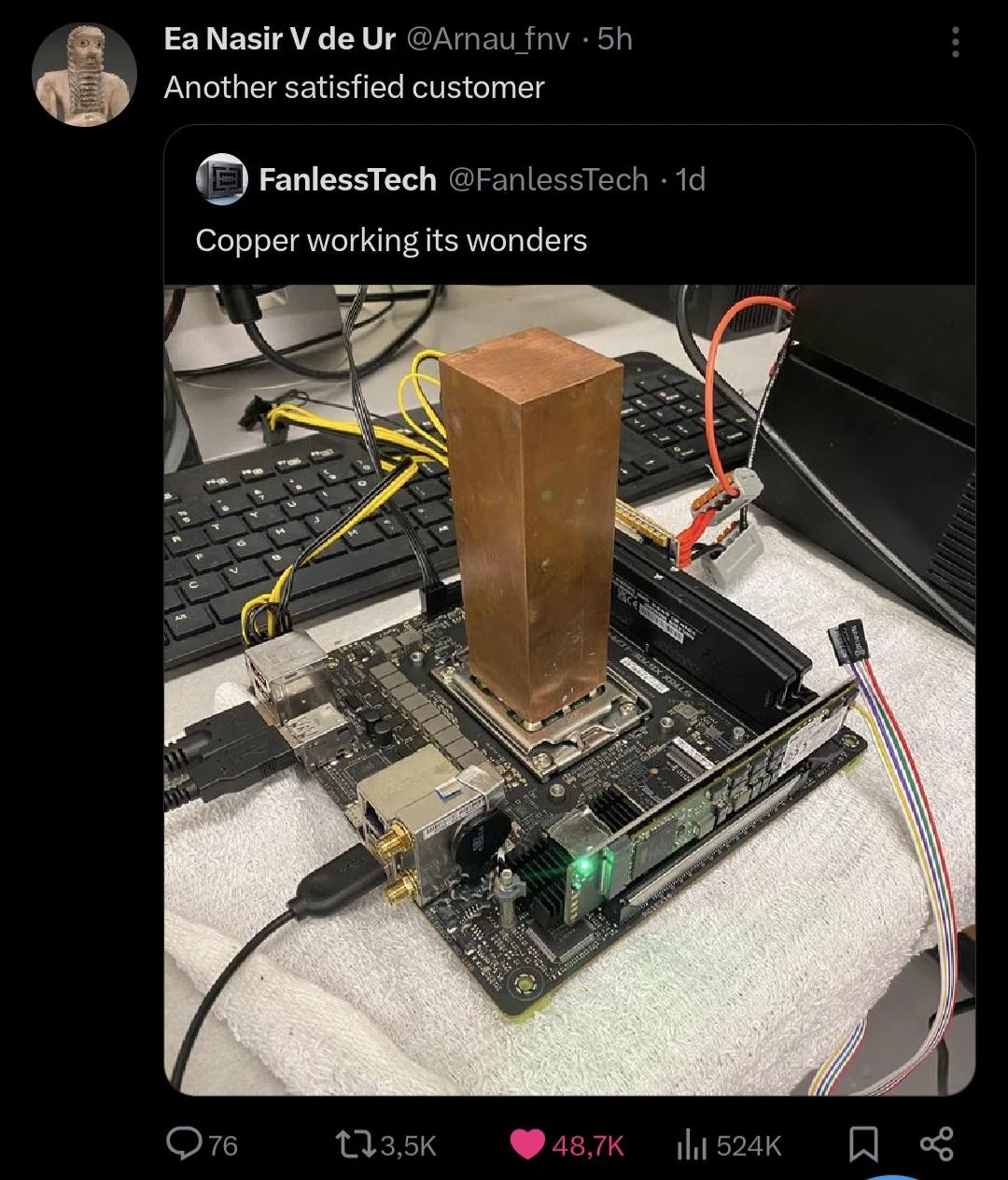
Why copper? Aluminum works way better as a dissipation surface.
Copper has more mass, heat capacity, and thermal conductivity per litre.
Is aluminium actually more effective as a dissipation surface? I hadn’t heard that.
Copper is better conductor but it’s worse at dissipation. Do the experience yourself, heat a block of each and then touch them afterwards.
Is that not because the copper holds more heat, so stays hot for longer at the same dissipation?
Maybe you’re right, but I remember than in the 2000s I’ve had identical cpu heatsinks in both copper/aluminum versions, and the aluminum one had better performance. And then they started to make hybrid ones, stating that the copper part was to allow rapid heat transference and the aluminum parts to improve dissipation. But maybe it was all marketing.
Aluminium is cheaper and lighter.
This seems to suggest that the metal-air transmission is virtually identical between the two, and cites some sources: https://electronics.stackexchange.com/questions/255731/copper-or-aluminum-heatsink
Dissipation = thermal conductivity. Copper is better in both, it’s just heavier and far more expensive. Are you sure you put the same amount of energy into both blocks there? A copper heatsink can generally be much smaller than an aluminium one.
The problems and complications with your method:
From what I have always understood, copper is technically better, but it isn’t dramatically better and it is heavier and more expensive. You likely couldn’t make a heatsink like the full sized Noctua’s and just mount them the way we do because of the weight alone. The price would also likely be double to triple.