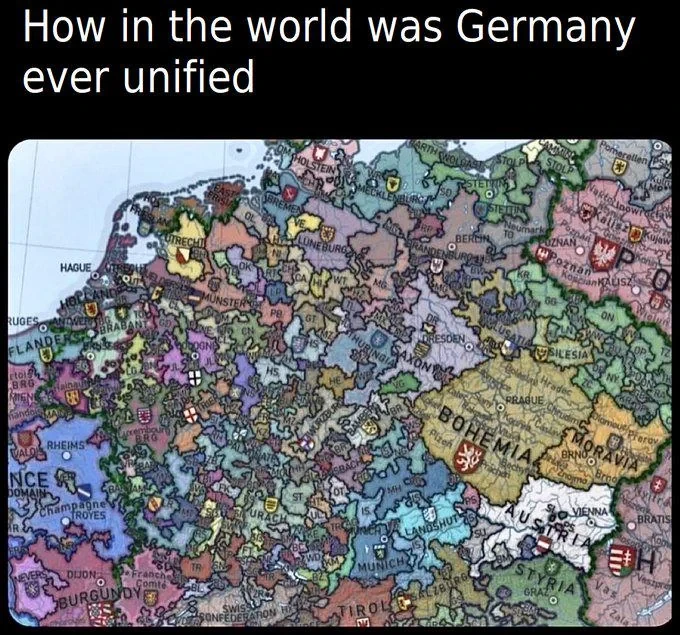
Explanation: In the Medieval and Early Modern period, the area we now know as Germany was home to a… staggering variety of independent polities.
… it would take quite some time for them all to be sorted out and put under one flag.
Fighting the French did help a lot
Hatred of the French brings people together.
The enemy of my enemy is my friend.
The enemy of my enemy is the French. Even if my enemy is the French, then the enemy of them is probably Parisians.
That makes Parisians your friends. They have the SAME goal as you. They can HELP you.
Interacting with France is the gateway drug to country-hood.
Nothing quite like the mutual desire to not be french for making friends.
It usually does, no matter the context.
Why didn’t Bohemia, the largest polity, not simply eat the other polities?
We ate Moravia, the second largest, so there’s that.
Ostwald wasn’t born yet
too busying creating the RHAPSODY?
Because reality is not Europa Universalis.
The smaller polities can ally.
Also, a single small polity can be relatively powerful based on its wealth and population density. It can also have local defensive advantages.
Napoleon. Yes, it’s a little oversimplified but that man really shaped Europe and Germany with it.
Napoleon the third to be specific. Bismarck helped. A little bit.
"France, under Emperor Napoleon III, viewed Prussia’s growing power with suspicion and sought to curb its influence.
The immediate catalyst for the Franco-Prussian War was the Ems Dispatch, a diplomatic communication edited by Bismarck to provoke French ire. The altered message made it seem as though the Prussian King Wilhelm I had insulted the French ambassador, leading to public outrage in France and a declaration of war on July 19, 1870."
"The Franco-Prussian War had profound consequences for both France and Germany, as well as for the broader European political landscape.
The most significant outcome of the war was the unification of Germany. On January 18, 1871, in the Hall of Mirrors at the Palace of Versailles, King Wilhelm I of Prussia was proclaimed Emperor of the German Empire. This unification shifted the balance of power in Europe, establishing Germany as a major continental power."
That’s not what OP meant. Napoleon I occupied the German states and brought a lot of reforms including the abolition of feudalism, legal reforms, and administrative efficiency including centralized state governments. He completely reshaped German state borders. As an example, this article (in German) explains how 250 independent territories were merged into 3 territories (which nowadays are one state).
Which ironically kinda makes him a founding father in a weird way.
France already knows that Germany likes to take French rulers and claim them as founders of Germany. See: Charlemagne.
I recall that the crowning of Wilhelm was preceded by quite a discussion of whether he’d be called “Emperor of Germany” or “German Emperor”
Holy Roman Empire, which was neither holy, roman or an empire(sort of).
At some point it included Rome, so at least that part is kind of true.
And it was also an empire
Every country around them kept lumping them together as ‘those fuckers in the trees.’ Couldn’t even agree on a name for them.
It’s a good thing Europa has moved past all that fractious border shenanigans

###Electorate of Cologne represent!

(*throws another archbishop to the curb*)
You know you done fucked up when your city gets attacked and your citizens run out to join the attacking army
Großherzogtum Baden FTW

I‘m gonna take a bath in Baden-Baden now.
(*throws another archbishop to the curb*)
Hey watch out, the new one hired mercenaries and is pillaging the countryside again!
What’s also fun is that you often still encounter these boundaries today. Many of those splotches are now administrative districts: https://en.wikipedia.org/wiki/Districts_of_Germany
And up until 2023, you often couldn’t travel by bus across multiple splotches without getting multiple tickets from the different regional providers. It was awful.
It was awful.
It was glorious. All Hail to the Holy Roman Empire of German Nation.
/s
*Zooms in a Prague to see if I can see any KCD2 locations *
God be praised! Henry’s come to see us!
The Italians did it, it looked like fun.
“By blood and iron.” I understand Bismarck after seeing that picture.
At the least, one understands the desperation of 19th century German nationalists in general. Border gore aside, imagine the tariffs and border controls one must go through for a simple day trip!
“Unification” = Prussian dominance through conquering, alliances, and coercion.
I find the standard historical descriptor “unification” to be statist embellishing and give the false idea that this was somehow grassroots.
Welcome to reality. It’s war. And diplomacy. Which is war with different means.
Why would anybody give up power if they didn’t have to?
I find the standard historical descriptor “unification” to be statist embellishing and give the false idea that this was somehow grassroots.
“War is politics through other means”, and all that jazz. German unification movements were widespread and a key component of Prussia’s success was leveraging that grassroots enthusiasm towards a unified German nation to assist them, by portraying themselves as the most likely to be able to achieve it.
Maybe people of the future will watch our Europe chart and wonder how United Europe ever managed to unite.
The same way Japan united.
sassage + musturd
I remember a period caricature from my school history book which featured a merchant with an ox cart being stopped and searched at 3 or 4 border crossings at the same time.