
You must log in or # to comment.
It’s because there they can sell them what they actually cost to produce instead of being forced to sell at a loss by the food industry.
That’s not an incentive for people to shop there. Grocery store prices are already bad enough. No one wants to pay extra money for a more limited selection.
I also much prefer the system that leads the farmer to kill himself. I can save money!
It is an incentive, just not price. People can choose to support a food system that provides a better living, less environmental damage, and other priorities. More people could choose that if they had more disposable income and I don’t fault people for defaulting to price when making purchasing decisions.
I for one prefer paying workers directly instead of supporting leeches
Farmers aren’t selling at a loss to companies in 99% of circumstances.
You know, some of them were just reselling grocery store stuff as their own.
I went to the co-op the other day, and they don’t even stock mostly local any more.

i never even considered this. ugh.
Found a booth that was selling vegetables from the US. The market refused to kick them out.
Nonsense my local farmers is 1/3 price of supermarket and last for 2 weeks in fridge ie is fresh.
Every year, I buy a farm share. My farmer gets his money for the year up front; he doesn’t have to borrow from the bank and he doesn’t have to worry about losing the farm if it’s a bad harvest. He gets to focus on growing stuff.
In exchange, every week during the growing season, I get 3/4’s of a bushel of just-picked vegetables. Some are rare heirloom varieties you generally don’t see; some are items you don’t see much of at all; and everything is fresh and lasts much longer than store-bought would’ve.
That’s an awesome suggestion. How does one do this? Are there a national registry?
Agressive takeover. You come to a farm with a suitcase full of cash and threaten the farmer’s kids and wife. You force him to take the money and when you leave, make sure to point a finger at him and say “I’ll be back next year to buy another share. I own you now!”
“Those are some nice vegetables you got there. Truly would be a shame if someone snuck onto your field every night and took a perfect cartoon bite out of every single one…”

You are describing the eating habits of groundhogs. They destroy just to destroy. Other animals take a few butes on one plant at a time. But those giant rats just chop shit down and repeat. I leave wildlife alone in general, but the first time these assholes manage to bypass the garden defenses they are taken out.
It’s generally called Community Supported Agriculture [CSA]; you should be able to Google “CSA near me” for results. You can also check localharvest.org , but sometimes their info is out of date or takes searching through. Like, a number of CSAs have drop-off points outside the farm that may be closer to you than the farm itself, or they may be willing to bring shares to a local farmers market that they’re selling at, etc, and Local Harvest tells you where their main farm is :(
Each CSA makes their own rules. Some places will give you a pre-filled box; others will let you pack your own box and choose between options (“Take any combination of 2: eggplant, zucchini, squash”). Some offer different size shares, others offer shares for half-seasons, or for 10-12 weeks and you choose the weeks. Some offer work-shares: you volunteer at the farm for a few hours each week, and you get a box of vegetables in return.
Many will also let you do some pick-your-own each week: often these are either excess vegetables (extra PYO tomatoes and peppers are common); are more labor intensive (blackberries); are things that not everyone wants (okra); are specialty items grown in smaller quantities (ground cherries); or are items where personal choice really matters (flowers); etc.
Most farms include some fruits with their vegetables; I’ve had three local CSAs (one couple retired, another was a bad fit for me) and I’ve gotten raspberries, blueberries, blackberries, strawberries, cantaloupe, honeydew, pumpkins, watermelon, apples, figs, pawpaw, and Asian pears.
They may also partner with other local farms to offer other local goods: locally grown grains, honey, eggs, meats, mushrooms, etc. They may have an end-of-season gleaning. Many will have some kind of (paid) community meal during the season, and many also provide produce to local [food banks / shelters / community kitchens / etc].
I will say that it’s a commitment, especially if you get the full season and full box share. The first month can be hard, as it’s a lot of leafy green vegetables, and eating half a bushel of green leaves every week for a month is a challenge. Over time, I’ve developed a set of recipes that let me cook whatever’s in season and preserve a bunch of stuff for the winter; and methods to deal with stuff that I get too much of too quickly.
So in June I make lettuce soup; it’s decent enough (not great), but it’s a fantastic way to use up lots of leafy green stuff when I get tired of salads and stir fries and frittatas, and I can freeze it. Bunches of onions here made into French onion soup and frozen; excess hot pepper gets made into pepper flakes or my own hot sauce; tomatoes become marinara or tomato paste and frozen, or salsa and canned.
I usually sit in front of the tv watching stuff for an hour or two while I slice and dice and chop; and then I spend a couple hours cooking. Half of whatever’s cooked goes into the fridge for the week, the other half gets frozen for winter meals. Anything not used in a dish either gets put into a salad for the week, bagged up for snacks, or frozen to be used as ingredients for later meals.
My freezer currently contains: French onion soup; eggplant Parmesan; pizza; seven-layer casserole; vegetable pot pies; lasagna; stuffed tomatoes and stuffed peppers; zucchini boats; pumpkin pie filling and sweet potato pie filling (just the filling, the pies are too bulky); zucchini bread; butternut squash bread; butternut squash soup; marinara; pesto; garlic confit; blueberry pancakes; strawberry muffins; raspberry jam; quiche; burritos; etc. My goal during the season is to do something with all the food that comes in (my starving Irish ancestors would never forgive me for wasting food!), and my goal during the winter and spring is to eat through my freezer so that it’s empty when the next season starts.
Oh this is what my friend does. He talked about this during a party this weekend. He only delivers to my city for CSA items but does participates in the farmer’s market in the town he grows in
Actually this is getting me excited. Maybe I’ll join again despite bing only one person!
Just checked my favorite CSA and they even have winter subscriptions, with separate mushroom and egg crops!
Edit: dammit, sold out. Registration opened Dec 1 so all the summer subscriptions are sold out. There’s one remaining fall subscription but that’s not my favorite
Fall is cool, you get all the hardy stuff that takes the year to grow - potatoes, sweet potatoes, pumpkins - plus the late summer crops - tomatoes, peppers, squash. Many CSAs have calendars of what crops usually come in when; you might check to see what theirs looks like for next fall. Or ask to be added to the notification list for when shares become available next December (or add it to your own calendar). :)
I also highly recommend these. We did them for quite a few years. The last one we tried also had u-pick flowers, plus programs for kids to learn organic farming and integrated pest management, as well as cooking. They also had a store for people not on the program.
I no longer subscribe because it’s just me at home and I can’t keep up.
The negative factor is you get what’s in season, which is not always what you want
Yeah, it’s just me now as well. I split a share with a friend for a few years, which was nice, we could pawn off anything we didn’t particularly care for on the other person. Mostly, it worked well - she loved beets, I hate them; I love garlic, she only wants like 2 bulbs a year.
Then my farmers retired during the pandemic and I had to find a new farm. My new place offers 10 week shares: any ten weeks during the growing season, I can go and pick up a box, I don’t even have to notify them ahead of time. I cook as much as I can and freeze about half of it, then eat my way out over the winter.
So you are one of those evil investors buying food futures then!111!?
evil cackling intensifies
Buy your garbage veggies from Mal-Wart then and don’t support your local CSA or local economy and don’t complain when all you have left is a Mal-Wart job in a Mal-Wart economy town
don’t complain when all you have left
Most farmers market sellers are also selling to mainline grocery stores and restaurants. You have to be incredibly small time to exclusively sell at market stalls every week or two.
Farmers markets are the perfect place to offload produce that is:
-
Too perishable to ship very far
-
Too “ugly” to sell to a distributor or store
-
Brand new to the market and/or limited run (experiments/new hybrid products etc.)
That last one especially is where farmers markets shine. Producers can connect directly with customers and get immediate feedback. Customers tend to be more interested/knowledgeable in the food/ag scene. They’re a great opportunity for producers to do some hands-on “market research” and test new stuff. The local stores that are “with it” and actually care about such things will also send their reps there to connect directly with producers and scout out the next new hotness in produce.
-
How dare people go to a grocery store.
There are “farmer’s markets” and then there are farmer’s markets. Riding your cargo bike to the once-a-week market in the urban hipster neighborhood’s park to pay $5 for a tomato is not the same thing as driving out to the actual state-run farmer’s market and spending $5 for a bushel.
Compare:
I live in a major metropolitan center and the farmers market downtown happens once a week.
The price can actually be quite good but you have to have reasonable expectations. If you see strawberries and there are snow banks outside well… Do the math. On the flip side if something’s in season you can often get a good deal.
A farmer’s market is not a grocery store so it does require a bit of savvy. If you see apples and it’s June those are probably last year’s apples from cold storage etc.
Sometimes “Farmer’s Markets” sell wholesale and even store bought goods for higher prices.
Sometimes people lie about stuff to make money?? Good god, I hope corporate grocery chains don’t learn about this ancient and secret power! Imagine what they might do!
Seriously, that article kinda buries the point about how few people doing it they were able to find - yeah it was happening, but it’s absolutely not some common behavior you can expect at a farmer’s market.
(Edit:) Other great quotes from that article:
In California, for example, each stand is inspected and vendors are required to display a certificate that outlines the produce they grow. No reselling of wholesale or out-of-state produce is permitted and markets are inspected by the state on a quarterly basis. Vendors who are caught breaking the rules can face suspensions, fines or even jail time.
Ed Williams, the man in charge of inspecting markets in Los Angeles County, says the system is important to prevent fraud and ensure “the consumer is not getting ripped off.”
Seems like the conclusion of the article is “we (canada) need to get our shit together, look even the US has this figured out”
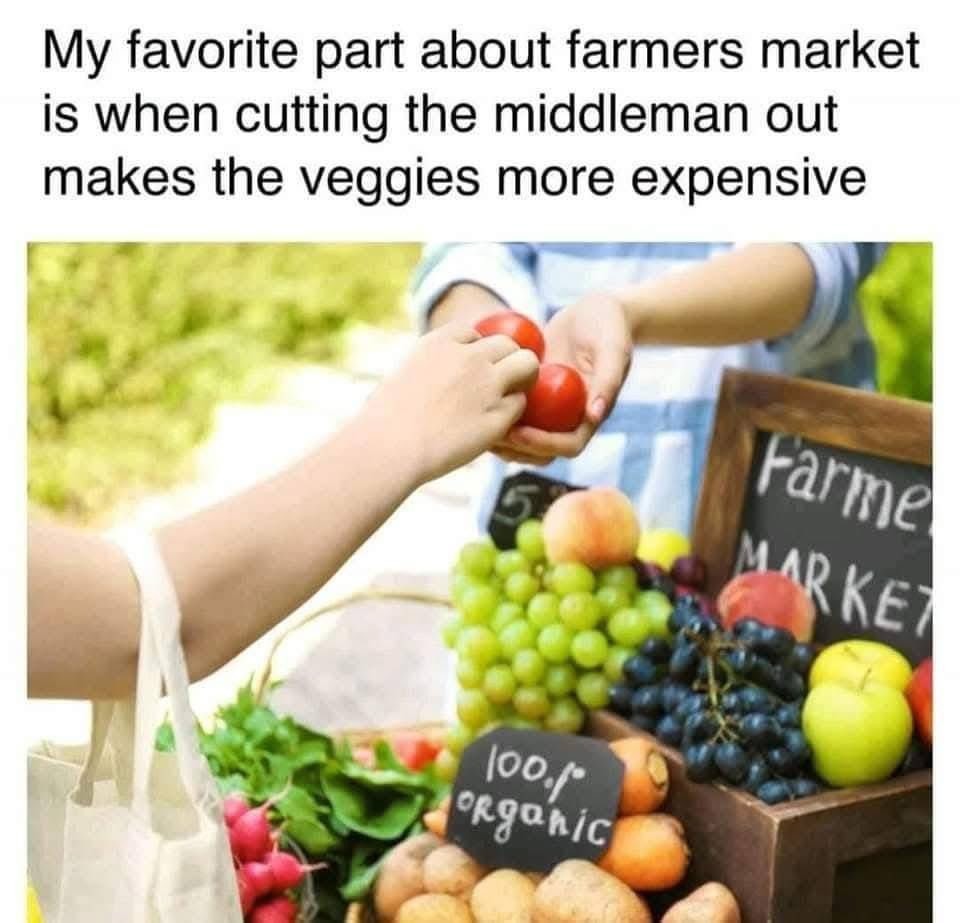
Big box supermarkets routinely pressure producers into accepting extremely low prices so that they can sell them for cheap in their stores. It’s either you accept the price or they don’t sell your produce at all. Farmer’s markets let producers sell their stuff at a price that allows them to live from their work
The middlemen exploiting the farmers and putting them in debt. Farmers exploiting immigrant labor to try to make ends meet.
It’s not really hard to work out if your head isn’t up your butt.
cause farmers markets are fake.
Its nothing but assholes buying shit wholesale from the same distributors that your supermarket gets their shit from (at much higher prices due to not having the super markets favor of volume), then pretending to be some salt of the earth farmer man/woman trying to get you to buy fruit and veg they “hand grew and loved”.
This depends on your farmer’s market entirely.
Plenty of the non-fruit/veg stands are also small shops trying to go somewhere with more foot traffic.
I literally know a guy who did a bunch of backyard farming and sold stuff at these, so they aren’t all fakes at least
Just look at their table.
If its in generic produce baskets and they are selling like 4 different things that are all available locally, yeah its probably from a local farm.
If the baskets are branded and they are selling 50 different things, yeah its probably from a distributor. (And that ok Tbh)
I live in the northern US. Farmer Brown is not growing bananas here.
Such assholes of course also exist, but here on the local farmers market, the one selling vegetables indicates what is stuff he grew himself, vs things he bought from elsewhere. So if you want to buy things from the actual farmer standing there, you’re perfectly capable of doing so (alas, just selling those things isn’t really an option. Not enough people come to such markets if they can’t find pretty much every vegetable they want…)
And regarding the price in this meme, that’s also a complex story. Can indeed be inefficiencies of smaller scale distribution of the same stuff. But on the other hand there is organic and “organic” farming. There is always a large push by the large scale organic farmers to keep the requirements of being organic as low as possible. So yeah, there is a big difference between large scale farms that just make the bare minimum requirements for being called organic, vs smaller scale farms that actually try to make their farm respect nature (which is kind of the point of being an organic farmer).
And in the end, it’s like all things in life, want to do it properly? Then spend time on actually learning who’s who, what’s what, if there is a farmers market, if they’re serious, i’m sure you can visit their farms. You can learn about the methods they use, and the impact of those methods, and then compare it to other methods of production, and see if it’s worth it for you, and see if the quality difference is worth it.
I know that I buy from resellers, actual farmers have a farm to run and don’t have time to run a stall. The produce is grown by actuall small farmers because the taste is markedly different
If you’re selling to the stores, you generally pack your produce and truck it to a central depot where they manage the shipping to the stores. If you’re selling it at a market, you have to pack your truck, rent the booth, unpack the truck for display, sit there all day(or hire someone to sit there all day), then pack everything up and drive home. It’s way more work and time to do a market.
Not to mention, some items are too perishable for shipping and/or they’re specialty items with limited supply, so no regional or national demand exists in the first place.
I live in an agricultural area and food from farmers markets is usually cheaper than at the store. But we have tons of farmers markets around here so maybe thats a factor.
Small markets are notorious for gouging the fuck out of the sellers. Want a booth at a farmers market or a makers market? Well you should expect to spend between $50-200 for the luxury to sell your own goods.
Don’t forget that most of these aren’t audited and you’ll be selling handmade goods next to someone else who is selling garbage from alibaba. Or you’ll be selling homegrown produce next to someone selling boxes of produce he bought from someone else.
Most of these markets are simply not profitable to farmers or makers. The buyers are few and they end up buying the cheaper shit after balking at the prices of anything made with care.
FUD
I guess I just live somewhere with real farms? There are 3 weekly farmers markets near me. All of them are something like 1/2 to 2/3 of the cost, and at least triple the quality of the grocery store.
I’m literally surrounded by farms and the store is cheaper. Unless it’s upick. When you pick it yourself it’s crazy cheap
Even with upick, it’s more expensive. The cost per pint of blueberries or strawberries we pick on the local farm is way more expensive than the grocery store. I guess they’re charging us for the experience.
Same thing for apples. $25 for a peck. We went to the store after and the same size bag was 99 cents.
You’re getting apples for 10 cents a pound at a grocery store?! Nah there can’t be right
I’m curious, is your farmer’s market like a grocery store or more like a bunch of kiosks in a central location once a week?
It’s a bunch of stands from local farmers and small businesses. They take up two streets in downtown every Saturday morning
That’s unfortunate. That’s more like a flea market being sold as a farmers market. An actual farmers market is just a grocery store with local products.
Same.
Also my local non-big-corpo supermarket has a whole section for local farmer stuff year round.
About 50% of the human race is middlemen and they don’t take kindly to being eliminated.
… isn’t the market a middle man? They charge for the booths.
No, they’re a cost of doing business.
i.e. a middle man
A farmer could set up a stand outside their driveway and advertise on Facebook, but the farmer’s market middle man acts as a go between to handle logistics and advertising and customer availability and creates a safe marketplace for customers and vendors.
No, that’s not what middle man means.
A middle man is an intermediary. I do not buy food from the farmers market. I buy it from farmers who have paid rent to be at the farmers market. The market is the landlord, not the middle man.
Landlords are middle men.
Is Amazon not a middle man? In many cases you’re buying directly from the seller, just like at a farmer’s market. Amazon, like a farmer’s market, exists to facilitate trade between sellers and buyers. It just collects rents.
No. Absolutely not. Landlords are middle men between tenant and the earth. But they are not middle men between consumers and commercial tenants.
Amazon is ABSOLUTELY a middle man because you DO NOT buy directly from the seller you pay Amazon and Amazon pays the seller.
Landlords are middle men between tenant and the earth. But they are not middle men between consumers and commercial tenants.
And commercial tenants can’t access customers without the landlord.
Face it, they’re middle men.
No, that’s just not true. You are trying to win through sheer force of linguistic bullshit. Landlords are LITERALLY not in the middle of any transaction between producer and consumer. They are BEHIND the producer.
Look at it from the flow of money. I get money from my wage. I go to a shop. I give the shop my money and receive a commodity. I do that every day, once per day. On the 30th day, the shop owner takes some of my money that I gave them, and some of the money other people gave them, and gives a specific amount to the landlord.
A middle man, on the other hand, is IN THE MIDDLE. The SHOP is a middle man for the PRODUCER. I go to the shop and buy a toy made by Hasbro, the shop owner takes my money and buys a replacement for that toy from Hasbro. The toy is made by Hasbro and used by me but the shop is in the middle of the transaction. The more toys I buy from Hasbro, the more the middle man makes. This is NOT the case with a landlord who IS NOT IN THE MIDDLE and therefore receives a fixed amount from the shop regardless of how much I spend because the landlord has no idea how much I spend at the shop because the landlord is NOT IN THE MIDDLE.
A lot of these markets are more community-focused and, yeah, they’ll charge something but not beyond the actual cost of putting the market together. They’re not making a profit. In some places the state or municipality will organize the markets in order to foster the local food/ag scene.
Do you think those things mean something isn’t a middle man?
The cost of putting the market together is always going to be higher than selling out of a van. Bigger venue, higher costs. It’s worth it for the increased sales, but the middle man still gets a cut. Even if there’s no profit, even if the cut is fair, there’s still a cut.
I made no such claim. The markets I’ve worked with have never taken a “cut” (I’ve seen the financials of some of these things. They’re non-profit, so no reason not to be transparent). They’re literally raising funds for the bare minimum of operations, so any use fees for the space, permitting fees, marketing (maintaining social media accounts, printing flyers etc.) insurance, etc. These are volunteer groups.