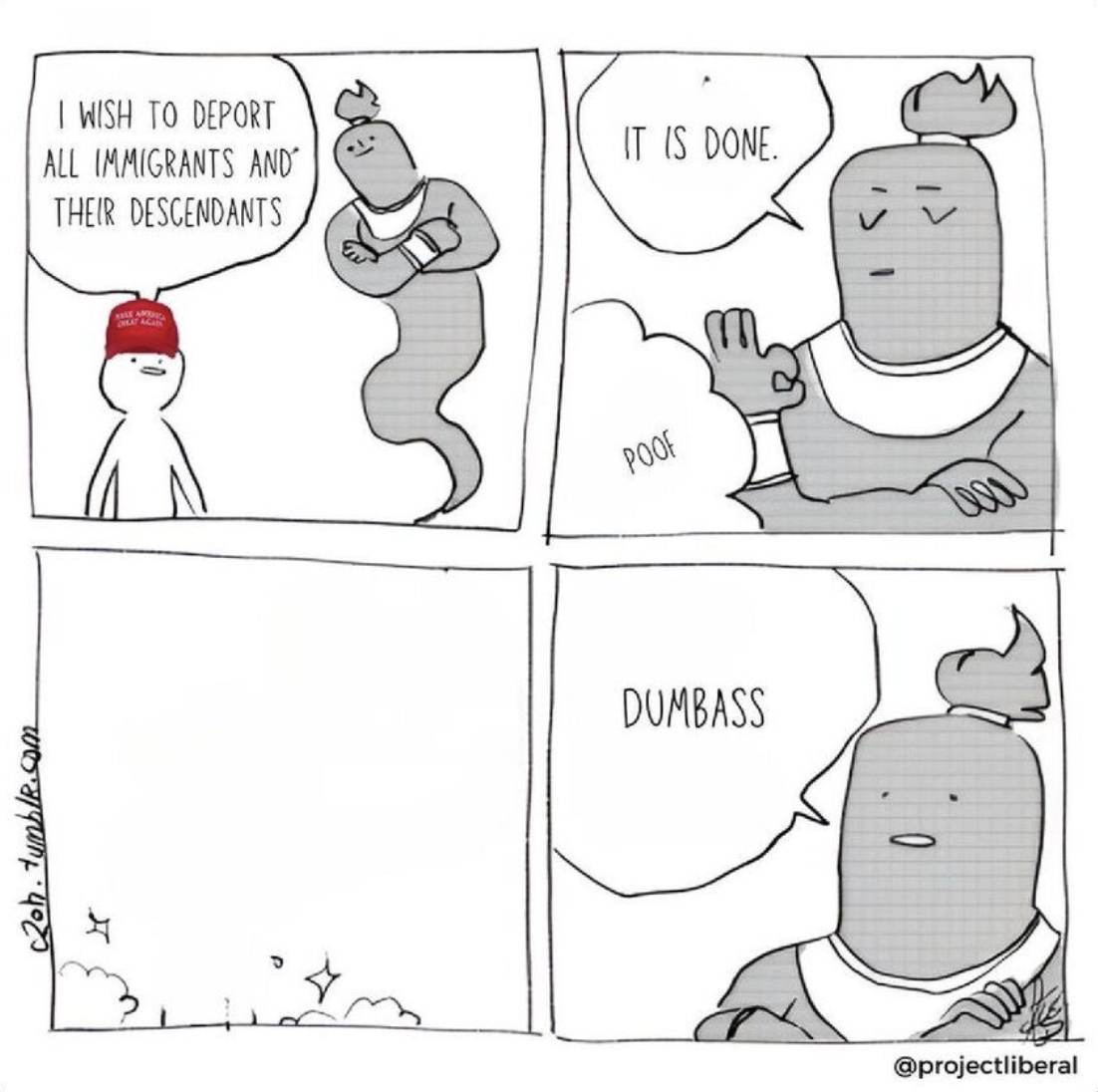

So, it’s a native American genie.
Native Americans are also descendants of immigrants technically
Everyone and every thing on land is an immigrant if you go back far enough because your super ancestors emigrated from the sea.
Every time white people try to prove that Native Americans weren’t here before they just end up finding more evidence that they were. I believe the most recent count is over 50,000 years in the LA area alone.
Yeah, it’s been a while
Correct me if I’m wrong, but the term immigrant implies there’s a rule of land and territory. Indians believed we all own the land.
Yeah looks like you’re right
The term immigration was coined in the 17th century, referring to non-warlike population movements between the emerging nation states. When people cross national borders during their migration, they are called migrants or immigrants from the perspective of the destination country. In contrast, from the perspective of the country from which they leave, they are called emigrants or outmigrants.
Go back far enough, and technically native Americans are immigrants too. Hell, even inside of Africa with how nomadic people moved around, if you go back far enough I don’t think there’s a single person on the planet who doesn’t technically qualify as a descendent of immigrants.
if you go back far enough I don’t think there’s a single person on the planet who doesn’t technically qualify as a descendent of immigrants.
so it was the aliens, or…?
The first land dwelling animal was an immigrant from the ocean. We would all drown.
Apparently the current model updates Out Of Africa theory to include some Hybridization with local traits from different areas as they travelled:
Current theories
Latest findings – including new fossils and improved DNA research and dating techniques – confirm the complexity of modern human (Homo sapiens) origins. Evidence still suggests that all modern humans are descended from an African population of Homo sapiens that spread out of Africa about 60,000 years ago but also shows that they interbred quite extensively with local archaic populations as they did so (Neanderthal and Denisovan genes are found in all living non-Africa populations) and these local populations contributed to our species’ success. So, while the general basis of the original Out of Africa model prevails, it requires extensive revision.
Recent African Origin With Hybridisation
Evidence indicates that Neanderthal and Denisovan traits emerge in Eurasia, while Homo sapiens traits emerge in Africa. Africa and Eurasia are isolated until H. sapiens disperses and interbreeds with the other two (and possibly some other unknown archaic species). Modern humans essentially absorb and replace the fragmentary local populations. The low percentage of Neanderthal and Denisovan genes found in living humans indicates a replacement process was most likely.
What remains unclear is how ancestral modern human populations were interacting in Africa. Did Homo sapiens originate from a small local population that then spread, as some believe, or via interbreeding between multiple groups across a wide area?
New fossil discoveries suggest that modern human physical traits did not emerge as one suite but were gradual. A skull from Jebel Irhoud in Morocco dated to about 300,000 years old, controversially assigned to Homo sapiens, had a modern-looking face but an elongated, archaic-looking braincase. This suggests our globular braincase evolved later and not as part of a fully modern suite of features.
Based on this and other early Homo sapiens remains, including those from Herto and Omo Kibish in Ethiopia, the African Multiregionalism Model of H. sapiens evolution was proposed in 2018 by a group including Eleanor Scerri and Chris Stringer (who proposed the original Out of Africa model). They suggest that early Homo sapiens showed great diversity and that rather than a single origin, our species emerged from admixture among numerous populations within Africa.
Assimilation Model
While most researchers agree with the RAOWH model, there are some that propose a different theory of interactions among human species and the role these interactions had in modern human origins. This theory differs in the way it explains how the DNA of Homo sapiens mixed with local populations outside Africa. Essentially, while some H. sapiens traits originated in Africa, it was when populations spread into Eurasia and extensively interbred with Neanderthals and Denisovans, that the evolution of new modern traits occurred. Thus, this model proposes, modern human origins involve a high degree of assimilation with archaic Eurasian populations within the last 100,000 years
Source:
https://australian.museum/learn/science/human-evolution/when-and-where-did-our-species-originate/
I think you need a nation for the concept of immigration to even make sense
There’s some place in Africa where, if you are talking only about humans, there may be people that is not descendent of immigrants. AFAIK nobody even knows where it is.
Every human on earth suddenly hanging out in some random place in Africa because the genie took an extremely literal interpretation.
Yep: Neanderthal and Denisovan genes are found in all living non-Africa populations
Source:
https://australian.museum/learn/science/human-evolution/when-and-where-did-our-species-originate/
Nomadic nature of humans would give you either a wide net or no single location.
Lol the countries most of America came from dont even exist as they were.
They get sent back in time
Me landing in 1850’s prussia
Hehe, Im in danger!
Some of them already are.
Everyone is now drowning in the ocean. Or possibly on an asteroid/comet flying through space. Either way: unable to breathe.
Why is genie tile?