You must log in or # to comment.
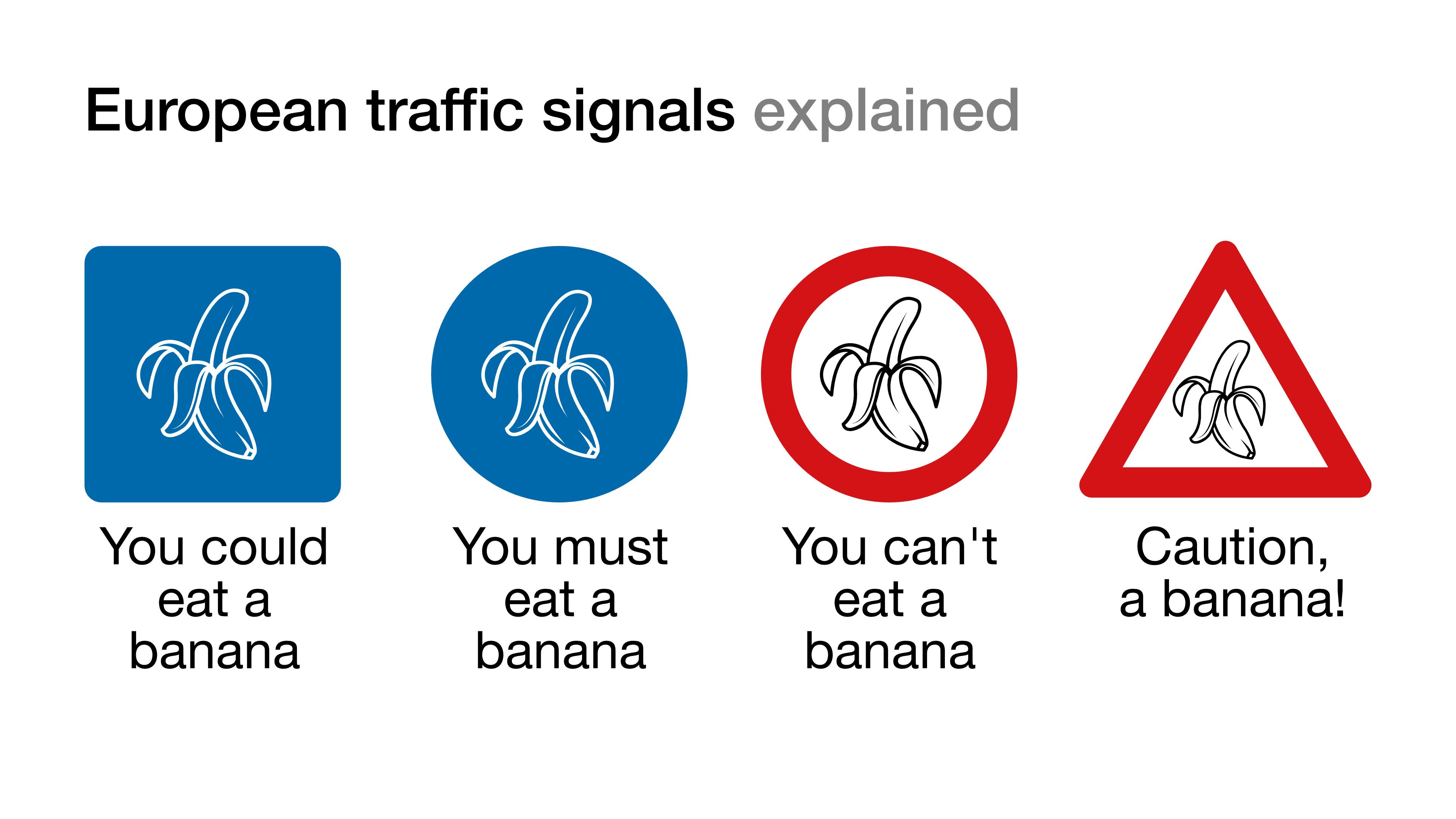
This is false, the signs are about whether you can, should or can’t peel a banana.
And a warning of a peeled banana.
Right! Obviously different from a warning for a hazardous banana peel:

And the warning sign for two unpeeled bananas, (really dangerous stuff)

Also, we import
allmost of our bananas from outside the EU.//Edit: I stand corrected. :)
🤓 Ackshually one can get EU-grown bananas from the French DOM-TOM.
or the Spanish Canary islands. To my own surprise EU grown bananas make up over 10% of EU banana consumption:

The Spanish banana industry must be fairly recent, as in the 1960s, the largest producer of banana in Europe was said to be Iceland, largely from a few experimental greenhouses.
It is not. Bananas have been introduced to southern Spain by the Arab Conquest. The industry on the Canary Islands is obviously newer, but was run as large scale plantations since the beginning of the last century. However the Canary Islands are probably African rather then Europe.
There is also banana production on the Azores (Portugal), including on the islands that are on the European tectonic plate.
Holy crap bananas grow so much further north than I expected, even without the gulf stream. Or wait never mind, the gulf stream apparently hugs North America until Virginia before heading to Europe. Wild stuff
I was once driving though one of the island (La Palma IIRC) and stopped to ask some older guy for directions. They guys says “yes, you’re going in the right directions. do you want some bananas?”. We thought he wants so sell us some so since he was nice to us we were like “sure, well take some”. The guy goes to his garage and comes out with huge bunch of bananas. We’re like 'eee… how much is that?" and he goes “no, just take them, I have too many”.
A lot of, not all. In Spain, most bananas are produced domestically in the Canary Islands. Also there’s a small but significant production in the French Caribbean.
Banana da Madeira from Portugal left the chat
I have offended people before, a lot, but never bananas. I guess that’s a first, then.
Blue square is more like
“Eat a banana if you can, but no pressure”
More like you have to eat the banana here if you want to eat a banana
for blue signs it’s not the shape that matters. a blue sign with an arrow is always a must. circular ones indicate what you need to do in your current lane (eg “keep right”), square ones on a lane you could turn onto (eg “the crossing road is one-way in this → direction”)
It absolutely is the shape that matters. A blue circle with an arrow indicates you MUST follow it, a blue square with an arrow indicates you CAN follow it. A blue circle with an arrow pointing forward can be replaced with a red circle with arrows pointing in every other direction, because it indicates a mandatory, I.e. you must eat the banana.
it varies. france and norway have some square mandatory “keep <direction>” arrows and sweden has the aforementioned “one-way in your direction” square arrow.
No, in general the shape 100% matters. Rectangular signs (not to be confused with supplementary plates) are almost always purely informational, with the singular exception that you mention (“one way” which is regulatory). See also: https://www.gov.uk/government/publications/know-your-traffic-signs/regulatory-signs
idk if using the uk in particular as an example there is very useful.
Depends on where in europe i guess.
Does it? Where in Europe is it different?
This isn’t accurate. Red circle around the sign means the maximum allowed. Like an 80 kmh sign. It doesn’t mean you can’t drive at 80. It means you can’t drive above 80
So, you can eat a banana, but you can’t eat more than 1 banana.
So what this one means:
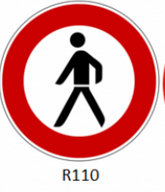
Maximum 0 pedestrians allowed?
you can’t eat a pedestrian
alno unironically yes. it means “no pedestrians”.
Exactly, it doesn’t mean “maximum allowed” but “not allowed”. “No pedestrians allowed”, “No driving over 80km/h allowed”, “No bananas allowed”.
if you parse the 80 sign as “keep below 80” then this would be “keep below 1 pedestrian”!
there’s a reason some countries have a line through the “no x” signs, i think…
I don’t know. I’ve never seen that sign in my life.
This is what we use. Personally, i think it’s less ambiguous.

It doesn’t mean you can’t drive at 80
I think it depends. You are technically allowed to travel at exactly the indicated speed (so the check would technically be ⩽ 80), but due to the nature of real numbers it’s also impossible to physically do. So in the most pedantic sense you must drive at less than 80 km/h and the requirement might as well be < 80.
It’s Your turn to eat the banana.