In English, the word “milk” has been used to refer to “milk-like plant juices” since 1200 CE.[11]
Wait, are you telling me milk thistle doesn’t come from cows?
Next thing I know you’re going to tell me peanut butter comes from peanuts!?
It comes from pee and nuts. Both are stored in the balls.
I want my money back!
Coconut milk
Coconuts have fur and produce milk. Definitely a mammal
Eh… It definitively doesn’t have fur. Are you talking about some interstitial tissue?
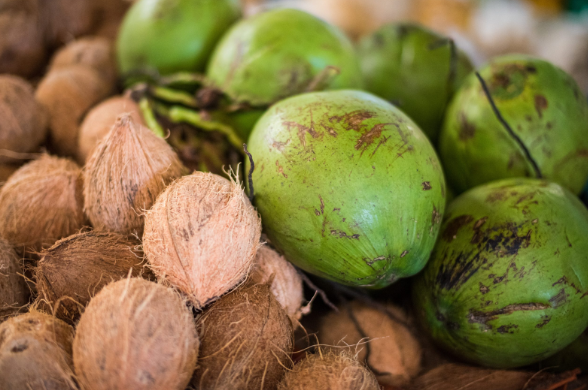
Mayor Poopington is likely talking about the fibre around mature coconuts (left).
Also known as coconut coir! Makes a great substrate for starting seeds and growing houseplants!
And for tarantula terrariums!
Some coconuts have fur.
Give me milk of the poppy and let me die!
Nobody ever seemed to consider the implications for Milk of Magnesia
I don’t care what words other than soy they put on my milk. The bean juice goes into my coffee and you cannot stop me!
Soy vanilla latte is a three bean soup
with creamer and sugar
You’re just hopped up on milk of paradise from the poppy for thinking this.
Thats bit of history is super cool, thanks for sharing! I will remember that
There’s so much interesting history with plant-milks! For the west, almond milk has an especially long history. Here’s an article about how there was a whole sensation around it in medieval Europe
Outside the west, soy milk has a very long history too.
A tofu broth (doufujiang) c. 1365 was used during the Mongol Yuan.[1][2] As doujiang, this drink remains a common watery form of soy milk in China, usually prepared from fresh soybeans. The compendium of Materia Medica, which was completed in 1578, also has an evaluation of soymilk. Its use increased during the Qing dynasty, apparently due to the discovery that gently heating doujiang for at least 90 minutes hydrolyzed or helped to break down its undesirable raffinose and stachyose, oligosaccharides, which can cause flatulence and digestive pain among lactose-intolerant adults.[14][15] By the 18th century, it was common enough that street vendors were hawking it;[16] in the 19th, it was also common to take a cup to tofu shops to get hot, fresh doujiang for breakfast. It was already often paired with youtiao, which was dipped into it.[17]
Thats so cool, thanks for the plant milk history lesson!!
I studied medieval recipes for specials when I was a chef. What a mindfuck to learn you need a grænde quontitye o almunde mylk afore ye smote þy pig.
Yep! It grew popular in medieval Europe periods during lent, but it ended up going far beyond that
But the sheer number of recipes from the Middle Ages that use almond milk, particularly those that combine it with (decidedly un-Lenten) meat, makes it clear that chefs came to regard it as a staple instead of just an alternative ingredient. Almonds turn up everywhere; in the first extant German cookbook, Das Buch von Guter Spise, dating to around 1350, almost a quarter of the recipes call for it.
[…]
Almond milk appeared in more overtly sweet dishes, too. A strawberry pudding could be made by soaking strawberries in wine, then grinding the mixture together with almond milk, sugar, and an assortment of spices, before boiling it all to thicken it.
[…]
Describing the diet of a pair of priests in 15th century Dorset in her book Food in Medieval Times, Professor Melitta Weiss Adamson, of the University of Western Ontario, writes that “almond milk must have played a significant role in their diet judging from the quantities of almonds bought.” She calls the late Medieval world’s appetite for almond milk not just a “love,” but an “addiction.”
https://www.atlasobscura.com/articles/almond-milk-obsession-origins-middle-ages
Amazing info. Thank you!
Orange juice is now called orange milk because now they’re just milking it. /s
Milk comes from tits, juice comes from nuts.
So do you make a big fuss about coconut milk?
Have you seen coconuts? They’re the tits of the tree.