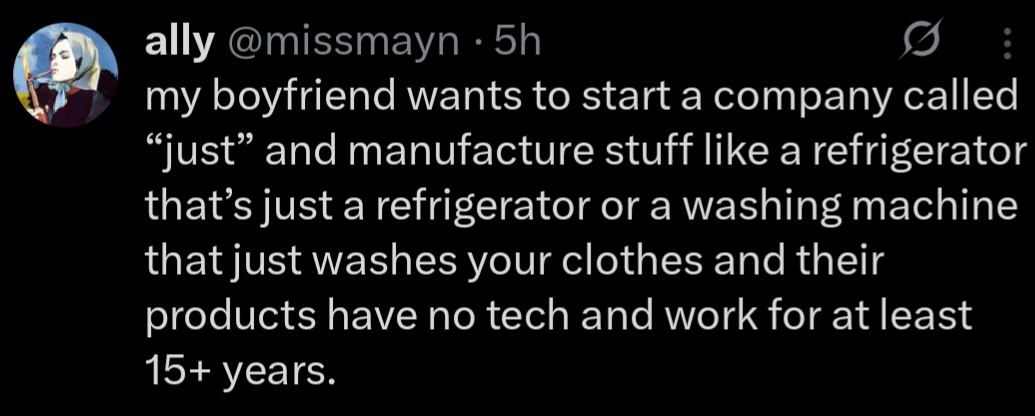

You must log in or # to comment.
There is a nonprofit org called Open Source Ecology that is aiming to create what they call the “Global Village Construction Set”, a collection of basic industrial machines required for modern living, designed in a way where everything can be built DIY by a single community (Including modular generators). I imagine that they have a plans for home appliances, I think as of now they’re still working on construction equipment.
That’s so cool. Yeah I’ve been thinking a great design strategy would be to build exclusively out of commonly accessible parts. Like, even repurpouse car parts if they’re more accessible, or use arduinos as the microcontrollers.
The thing about, say, a washing machine is there’s not a ton else that has a hefty spider/shaft/tub combo like that. The forces involved in spinning a few kilos of clothes isn’t trivial. I’ve been harbouring thoughts of open source appliances for a while.
What I kind of feel might be viable are modular, generic controller boards for dryers/washing machines/dish washers.
Love the concept but doesn’t seem to have many plans.
It does seem to have fizzled out a bit, sadly. They need to collaborate with other established groups doing similar things, IMO.
I think this is the way you have to do it. Open hardware designs. If you make a product that’s so reliable that it never breaks, it’s a product where you never get repeat business. If it’s a super simple thing that doesn’t need or get new features, you can never sell someone an upgrade. That’s great for the consumer, but not great for the appliance maker. So, there’s always an incentive for them to enshittify.
There’s a huge demand from consumers for that. Just not from investors.
There’s a huge demand from consumers for that.
Is that actually true, though?
Very likely. Why not?
Because consumers have shown to prefer features over reliability:
French Door refrigerators are the most popular and most complex design.
Built in ice makers are popular but also complex and prone to failure due to physics.
They still sell very basic refrigerators and washer/dryers. But these don’t sell as well as more feature rich models.
In my albeit anecdotal experience, these ‘very basic’ appliances suffer their own variant of faults. They take no modern design cues; they are more prone to reliability issues from bargain bin components; or they somehow cost only slightly less than their fancy feature rich counterparts.
Just because I don’t want off-white equipment in my kitchen, I shouldn’t have to buy an ‘AI’ oven. But the companies want to know when and what I’m cooking so when I go to the grocery in the middle of dinner prep, the AI price labels can adjust a bit higher because they know I need an ingredient right now for a meal I’ve already started making.
The variant of fault these normal appliances have aren’t truly a fault. It’s intentionally made to be less appealing, less reliable, and more expensive than it should be, so when we’re looking at a white oven in the store for $800, we’ll opt instead for the $1,000 Alexa powered stainless steel double range that’s sitting right next to it.
Oh and if you’re in a spot and need to finance your new appliance, sorry but our financing isn’t available for the budget tier.
This comment kind of went off the rails, didn’t it.
People would likely want products with new features and reliability.
But what we actually have on the market is products with new features that are mostly unreliable, and slightly cheaper products with less features that are similarly or more unreliable. Our products are clearly regressing in quality even if the existence of luxury features or designs are rising.
We are in a hostile relationship economically where almost every manufacturer is engaging in planned obsolescence (instead of using resources appropriately and making the products we want which also last).
Corporations want us to keep buying - they are hyper-focused on perpetuating that reality.
My recent experience buying such is that it is very very hard to find basic but quality models. If you’ve had a water dispenser or ice maker once, you realize how awful they are. They take up massive amounts of fridge and freezer space and need expensive filters every 3 months and break as soon as the short warranty is over. But if you want double door and bottom freezer you pretty much have to buy the crap extras as well.
I don’t think complex design is the opposite of “just” it’s more that the refrigerator is just a kitchen refrigerator that doesn’t have weird proprietary temperature management system, and easily accessible replacement parts. It’s not also a built in tablet for example
But are there simple fridges that don’t look like rental apt fridges? If there was a nice simple fridge with a big bottom freezer, in stainless, I bet it’d sell. Tho water dispensers and ice makers are damn convenient when they do work.
“all the companies are dumb and refuse to earn money this simple way that I discovered in a showerthought”
Half of people on lemmy, facebook, reddit, twitter…
Ok, how about I would have bought one for a couple houses I’ve renovated?
Yes. Cars especially right now.
I’m just going to run my car until it no longer functions because I can’t be doing with all of these crappy infotainment systems. My car has a non-functional radio and that’s it, it’s so old it has headlights that don’t even blind people, and buttons to control the AC.
There’s a huge one-time demand from consumers. But, if it’s an amazing device that never needs repairs (or that can easily be repaired by the consumer) and it has no bells and whistles, that’s a problem: there’s no repeat business.
Who cares?
The people running the business, presumably. Generally people don’t want to go out of business because they can’t find any customers.
Once you’ve supplied everyone with it, figure out how to keep a buffer stock and move onto the next product. By the time you’ve sold every viable customer a washing machine, vacuum cleaner, fridge, freezer, mixer, cooker, dryer (whatever) they’d be fine, new stock still needs to be sold eventually so keep a trickle coming. Replacement parts etc.
Biggest issue is it’s going to be expensive - will people pay?
That sounds like a difficult way to run a business.
It’s how businesses were run for literally hundreds of years.
Not true at all. Businesses didn’t move onto the next product, they specialized, making the exact same thing year after year. Because manufacturing tolerances weren’t great, things would need repairs and replacement, so there was repeat business. Nobody kept a buffer stock and moved onto the next product.
Investors need not be shareholders, to be fair.
these exist, see speed queen
the cost is going to be higher, though, because “smart” widgets can offset their initial costs through the projeted sale of the data harvested over the life of the widget
most people being ignorant to this and to the inevitable issues with corporate-built “smart” widget infrastructure, the cheapest option will generally be the most popular
my inner doctorow says that the twiddlers did this on purpose to undermine competition, especially considering the attempts to keep those widgets from being liberated
The same thing is happening with cars. Good luck trying to get a new unconnected vehicle, and good luck to the company who plans to sell them.
The Sims did it first, except the brand was called “Justa”. Justa dishwasher. Justa fridge.
I want to produce boxed recipes under a product line named “Jamaican”
- Jamaican a pie
- Jamaican mac and cheese
- Jamaican chicken with mushroom gravy
I also wanna make a perfume line named “Eureka,” following the same general idea but with awfully generic scent names
- Eureka flowers
- Eureka citrus
- Eureka chicken with mushroom gravy
It’s the Linux philosophy in appliances. I’m down.
50/50 chance it sells at a premium compared to other models, making the entire idea useless
Source: Like every project that pretended to do this with their respective market
Why the hell is a light phone more expensive than a mid to high range model smartphone. I’d rather just buy that and swap the ROM if I want to remove google.
Economies of scale and not capturing data as part of your profit model
Yeah I know my sample size is pretty useless, but this was just a dumb excuse to complain about light phone because even SMB manufacturing cost wise, it should be almost comically cheap to produce.
There are lots of other hardware accessories in the same range that cost much less to buy as a consumer, that are produced by more expensive vendors.
Yeah but what is the volume they are selling and are they profiting from user data both of those things have a significant impact on price.
A total absense of tech would be bad for a washing machine. With a really simple conductivity sensor (basically just two electrodes on the sides of a plastic pipe) and an opacity sensor (an IR LED and an LDR on opposite sides of a clear pipe), you can measure how much stuff is dissolved in water and how much insoluable stuff is suspended. That then means that you can keep circulating the soapy water until it stops getting dirtier, then keep rinsing it out until it stops getting cleaner, which then means you can have the cycle times adjust themselves to how soiled the load is, instead of just making them as long as the worst case scenario might require and wasting energy, water, and time on an average load.
I think ive never seen a washing machine that doesnt do a pre-determined amount of cycles. That exists? And I thought I had a rather sophisticated washing machine.
I think the way it normally would work would be to do the existing steps for a bit longer if necessary or stop them early if possible, but the washing machine I’ve got at the moment sometimes gets its timer all the way to one minute and then adds an extra ten and starts rinsing again. In theory, that should be less likely to happen if you’re separating the washing by soiling levels like the manual says, but some of my family don’t believe the manual.
Ah ok. I havent really read much of mines manual. But i did notice that the timer is often wrong, it seems to go slower than actual time. Would make sense if it is measuring something in the water and just putting an estimated timeon the display. I thought it was just a bad clock…
And easier to repair, too.
A GE washing or drying machine from 30 years ago has easily removable panels, about 4 to 6 screws each and large easily identifiable parts, but one from a couple of years ago requires the top to be propped up or secured and the panels removed in a specific order such that you can them remove the internal plastic panels through which wires need to be dismounted around the drum with like 8 or more screws each of varying sizes and when it comes time to put it back together I hope you’ve got more than three arms because fuck you thats why.
Deshittification
There’s a supermarket in Canada, that has a brand like that. It’s bright yellow and black and only has the product name in bold writing on it.
Loblaw’s and their subsidiaries. The brand is literally called No Name (Sans Nom). It always gave me a chuckle when I lived in Canada.
Obligatory fuck the Loblaws, but the No Name thing is a neat concept and certainly very recognizable.
Great marketing from a terrible company
and sometimes it’s actually good value!
I still don’t buy it because fuck Loblaws, though
Fuck Loblaws.
Maybe not only just work for 15+ years. But allow parts to be purchased and easy manuals to read for at home repairs.
It’s now required by law in Europe that spare parts needs to be available for at least 10 years.
That’s been a law in the US for cars for ages.
This specifically makes me so much more likely to buy a product.
seriously, being able to fix the washer/dryer ourselves has saved us so much money
I’d go even further and say, release documentation that shows how to DIY new parts from scrap you got laying around or can find in construction debris and junkyards.
Hell yes
Like No Name does for groceries.
Does ordinary skincare count too?
Gonna have to rebrand all that to Just A Dream, unless you have a plan to secure the capital to start that all up, and also somehow not be beholden to short term profit crazed investors who will change that business model.
Hooray! Hypercapitalist Realism!
I’m not against it having an open API to allow it to be controlled by some computer system, though don’t even bring up the word “cloud”.
The problem is they start including features no one wants. Like my dishwasher has an app, why?
It’s not like it can fill itself so I can put the dishes in the dishwasher and I can start it remotely, but since I have to put the dishes in the dishwasher it’s pointless to then not immediately turn it on, it’s not like the dishes will care if they’re sat in the dishwasher for a few hours. What is the point in me being able to remotely turn it on from my phone?
The app also lets me set a start time, which is a doubly pointless feature because I could just remotely turn it on with the app whenever, if for some reason I cared about that.
Imagine how much better the dishwasher would be if the people who’d spent the time building the world’s most pointless app, instead worked on literally any other aspect of the dishwasher.