PugJesus
History Major. Cripple. Vaguely Left-Wing. In pain and constantly irritable.
- 3.29K Posts
- 3.24K Comments

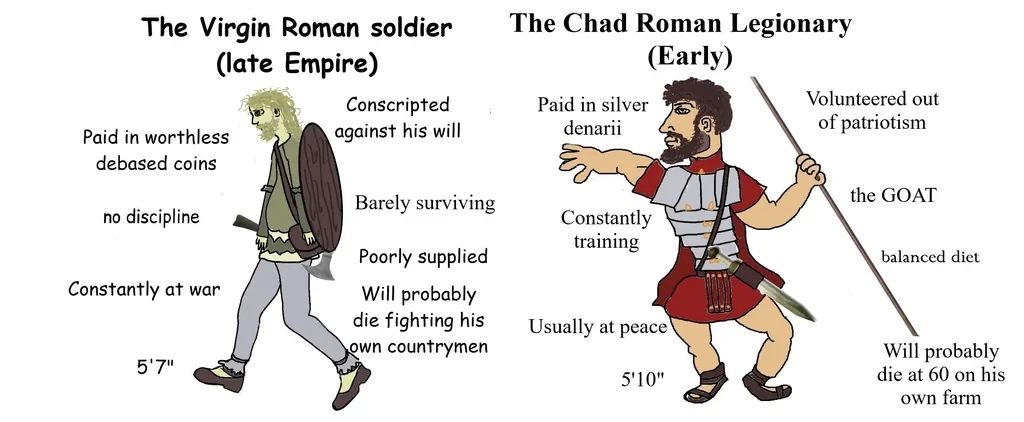
Notes: Legionaries of the Early Roman Empire were supposed to be 5’10… in Roman feet, which is around 5’7 (174cm). Archeology supports that shorter men were regularly accepted.
Legionaries of the Late Empire were often not regularly paid in coinage at all, but reimbursed in-kind - that is to say, supplied with food and equipment. Bonuses were still distributed in coin, but were irregularly received and not always easy to spend anyway, on account of the whole “Empire falling apart” bit.
Estimating the lifespan of an average legionary (if there could be said to be such a thing) is incredibly difficult with most records being obliterated by time. ANY estimates offered will always be DEEPLY contentious. However, one article I read posited, acknowledging the shortcomings of the available evidence, that the average lifespan of a legionary in the Early Empire was about the same as the average man of the Early Empire. That is to say, whatever dangers Roman military life offered, they were about equally offset (in this proposed interpretation of the limited data) by recruitment preferences for healthy men, reliable access to a robust and healthy diet, and free top-of-the-line medical care. Estimates of lifespans in the Late Empire, military and civilian, are generally accepted to be… worse.
“Patriotism” is an old Latin term meaning “a steady paycheck”, at least in this context.
 5·2 hours ago
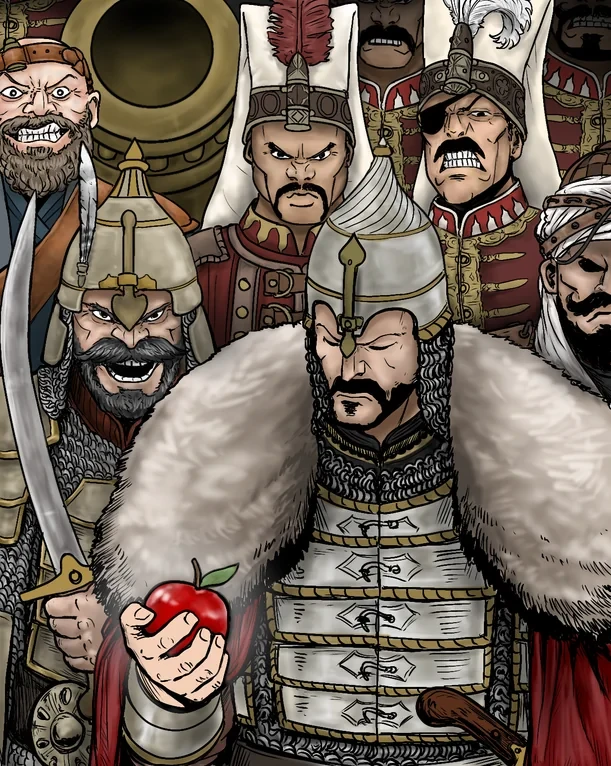
Explanation: Mehmed the Conqueror, of the Turkish Ottoman Empire, was the ruler who finally finished off the long-enduring (but long-sickly) rump state of the Byzantine Empire, centered in modern-day Greece and European Turkiye, by conquering the formidable fortified city of Constantinople (now-Istanbul).
Look out for the cannon in the back!
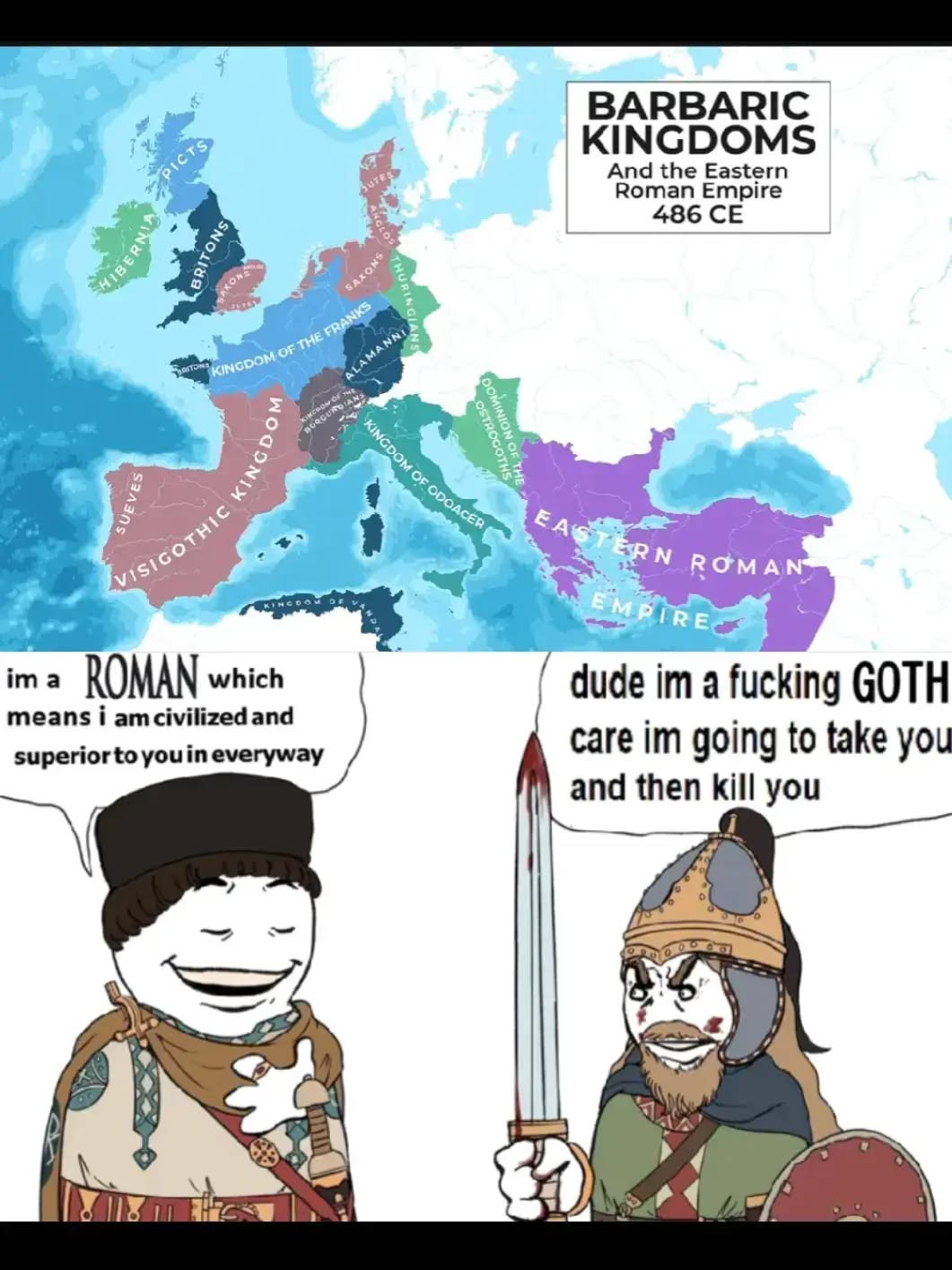
Explanation: In the Late Roman Empire, various Germanic tribes (including the Goths and Vandals) overran the Western Empire entirely, and established themselves as long-term residents of the areas they conquered - most relevant to the meme, Spain/Portugal and North Africa. Rather than reveling in the destruction of civilization, these Germanic tribes were largely looking to settle on land that they wouldn’t freeze to death and die horribly in, trampled by other, Central Asian migrating barbarian tribes. Thus, a large part of the appeal of Roman lands was that it was already ‘mapped out’, so to speak - not vast, unknown forests separated by hostile tribes, but mostly cohesive lands where everyone already knew where the good farmland was and all that was needed was a little ‘transfer’ of ownership!
For that reason, and the prestige/well-established culture of Rome, many of these Germanic tribes went through great pains to present themselves as Roman to the new lands they ruled over, even adopting large parts of (Late) Roman law in the process. They would be the best damn Romans they could be!
… but a few short centuries later, the Arab-dominated Umayyad Caliphate (the cultural Arab chauvinism would actually lead to its eventual downfall and replacement with the Abbasid Caliphate), championing the then-new faith of Islam, would overrun North Africa and most of Spain in turn. The response of the Germanic ruling class of North Africa and Spain?
… be the best damn Arab Muslims they could be!
Explanation From Original OP:
In his autobiographical Confessio, St. Patrick wrote that upon trying to secure passage on a ship to escape slavery, the pagan sailors offered their breasts to be sucked. He refused, stating it was “out of reverence for God”. In pre-Christian Ireland, offering a nipple to be sucked or kissed was an ancient Celtic custom, it served as a symbolic gesture of submission, asking for protection, or swearing loyalty to a superior or chieftain.

I think I see what I missed, edited to make it a little more clear.
The nomenclature for the years is based on the presumption that there are two people.
“The Consulship of Julius and Caesar” subverts that by using the two-person structure for a one-person occurrence.
In Fight Club, Tyler Durden and Jack are presented as two different people, but the climax of the movie reveals they’re actually only one.
Explanation: Prussia, getting rather irritated at Napoleon’s meddling in its sphere of influence in Germany, declared war on France without consulting its allies or making a deeper plan than “Fight Old Boney” in 1806. In the past decade, France had already thrown back several massive coalitions that had been arranged against it, and Napoleon himself had delivered a crushing blow to the Third Coalition consisting of most of the major powers of Europe just a few years before.
… Napoleon destroyed the entire Prussian army and took the country inside of three weeks.
Explanation: Julius Caesar (of later dictator and conqueror fame, but at the time just an up-and-coming politician) was a reformist who was elected to the Consulship, the highest (two) office(s) of the Roman Republic, along with a decidedly conservative colleague, Bibulus.
Caesar crafted a piece of land reform legislature which removed all the stated reasons the conservative opposition offered for sinking prior land reform proposals, and ensured that it was high-profile enough that conservative leaders could not avoid addressing it. The ultraconservative Senator Cato the Younger, who hated Caesar’s guts, established the ‘party line’ of the conservatives - that it was a good piece of legislation (they could not deny that without sinking their own credibility) but that it was, in some vague way, the ‘wrong time’ for it.
This mealy-mouthed refusal was not enough to stop Caesar. Caesar, ever-the-showman, immediately set to pressuring his political foes with enthusiastic crowds - rather than seeking to intimidate them, he sought to make it impossible for them to refuse the demand of the crowds without appearing anti-democratic. Most significantly, he pressured his colleague, Bibulus, who had the power to effectively veto* legislation (as did Caesar) as one of the two consuls for the year. Bringing his colleague to the People’s Assembly, where the proposal would be voted on, Caesar addressed him amicably, offering him the platform to offer his reasoning for being against the bill. When his objections had little substance, Caesar led a crowd of Roman voters to cheer his name and beseech him to support their cause of land and bread for the poor citizens of Rome.
Bibulus refused several times, but eventually lost patience, and snapped at the crowd, “You shall not have [this legislation] even if all of you should want it!”
That was a bad response to a Roman crowd which still understood its political power. The mood turned very sour very quickly, and the crowd heaped invective and abuse upon Bibulus. Caesar made no effort to restrain the crowd at this point - in part because that would have damaged his image, and possibly in part because Caesar may have suspected Bibulus would have made such a blunder and desired the outcome. Bibulus would be thrown from the speaker’s platform, and the fasces (bundled sticks and axe) of his lictors (attendants) broken - a symbolic rejection of his magisterial power. The chaos would end with a chamber pot being emptied over Bibulus’s head by an upset voter.
For understandable reasons after that taste of what he could expect from Roman politics, Bibulus did not leave his house for the rest of the year (though he, unlawfully, attempted to veto all legislature without attending Senate meetings). This left Caesar as the only Consul who was actually in attendance during Senate meetings. The land reform bill would be passed shortly thereafter.
Since Roman years were traditionally named after the consuls elected in that year, the year became jokingly known as “The Consulship of Julius and Caesar” instead of “The Consulship of Bibulus and Caesar.”
*it was not a formal veto over legislature which the Consuls held, but the ability to declare ‘bad omens’, which was not supposed to be abused, but obviously was. Consuls could only formally veto each other’s actions. Formal legislative veto power was held by the People’s Tribunes - Republican Roman constitutional authority was all over the place
Yep. I think it was the great Roman general Germanicus (“Conqueror of the Germans”) who came across it, and stopped his furious vengeance-campaign briefly for the purpose of giving the Roman corpses a proper send-off as best as the Legions could.
Explanation: The Nazis, formally the National Socialist German Workers’ Party, are sometimes claimed to be socialist by modern right-wing chuds who want to distance themselves from the Nazis (and blame leftists for it instead).
… the only major opposition to the Nazis before their effective coup were socialists, who engaged in street fighting with Nazi thugs in an attempt to save Weimar Germany from its own idiotic self; and after the Nazi coup, large amounts of socialists were imprisoned and killed for the crime of being socialists. The Nazi Party was not aligned with socialists in any meaningful sense, and Hitler defined the Nazi Party’s particular brand of socialism very… curiously.
‘Why’, I asked Hitler, ‘do you call yourself a National Socialist, since your party program is the very anthesis of that commonly accredited to Socialism?’
‘Socialism’, he retorted, putting down his cup of tea, ‘is the science of dealing with the common weal. Communism is not Socialism. Marxism is not Socialism. The Marxians have stolen the term and confused its meaning. I shall take Socialism away from the Socialists.
‘Socialism is an ancient Aryan, Germanic institution. Our German ancestors held certain lands in common. They cultivated the idea of the common weal. Marxism has no right to disguise itself as socialism. Socialism, unlike Marxism, does not repudiate private property. Unlike Marxism, it involves no negation of personality and, unlike Marxism, it is patriotic.
‘We might have called ourselves the Liberal Party. We chose to call ourselves the National Socialists. We are not internationalists. Our Socialism is national. We demand the fulfilment of the just claims of the productive classes by the State on the basis of race solidarity. To us, State and race are one…
https://en.wikipedia.org/wiki/Anglo-Zanzibar_War
The Anglo-Zanzibar War was a military conflict fought between the United Kingdom and the Sultanate of Zanzibar on 27 August 1896. The conflict lasted between 38 and 45 minutes, marking it as the shortest recorded war in history.[3] The immediate cause of the war was the suspicious death of the pro-British Sultan Hamad bin Thuwaini on 25 August 1896 and the subsequent succession of Sultan Khalid bin Barghash. The British authorities preferred Hamoud bin Mohammed, who was more favourable to British interests, as sultan. The agreement of 14 June 1890, instituting a British protectorate over Zanzibar, specified that a candidate for accession to the sultanate should obtain the permission of the British consul;[4] Khalid had not fulfilled this requirement. The British considered this a casus belli and sent an ultimatum to Khalid demanding that he order his forces to stand down and leave the palace. In response, Khalid called up his palace guard and barricaded himself inside the palace.
The sultan’s forces sustained roughly 500 casualties, while only one British sailor was injured. Sultan Khalid received asylum in the German consulate before escaping to German East Africa (in the mainland part of present Tanzania). The British quickly placed Sultan Hamoud in power at the head of a puppet government. The war marked the end of the Sultanate of Zanzibar as a sovereign state and the start of a period of heavy British influence.
Explanation: During the reign of the Roman Emperor Augustus, the Roman Empire sought to expand into Germania, and had significant success in doing so.
A rather cunning Germanic fellow by the name of Arminius (sometimes Hermann in German histories) with designs on becoming king of Germania allied with, then betrayed the Romans in an ambush in Teutoburg Forest, wherein three entire Roman legions (roughly 15,000 men, ~10% of the entire Empire’s forces) were wiped out,
We should have statues of this brave man 😭





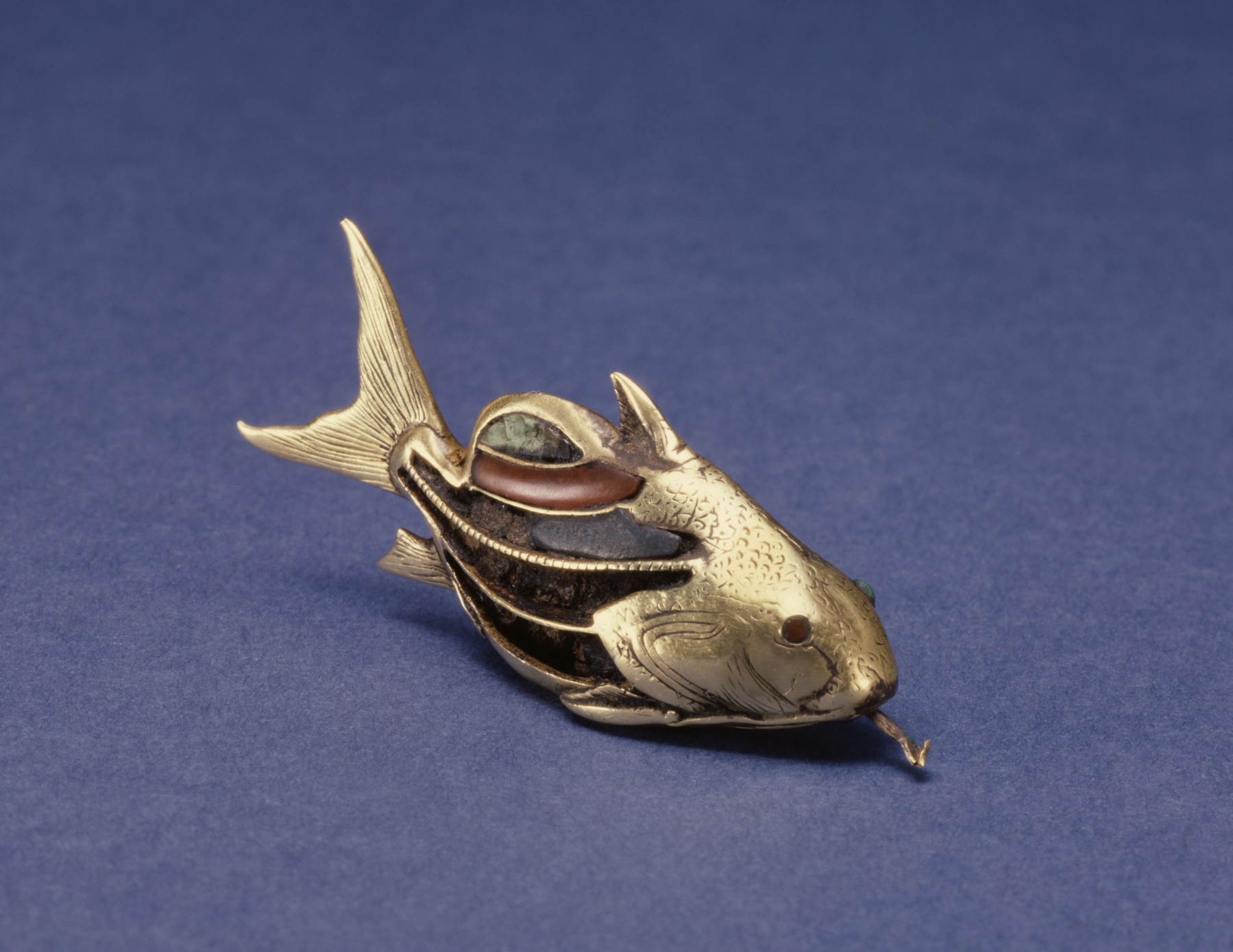
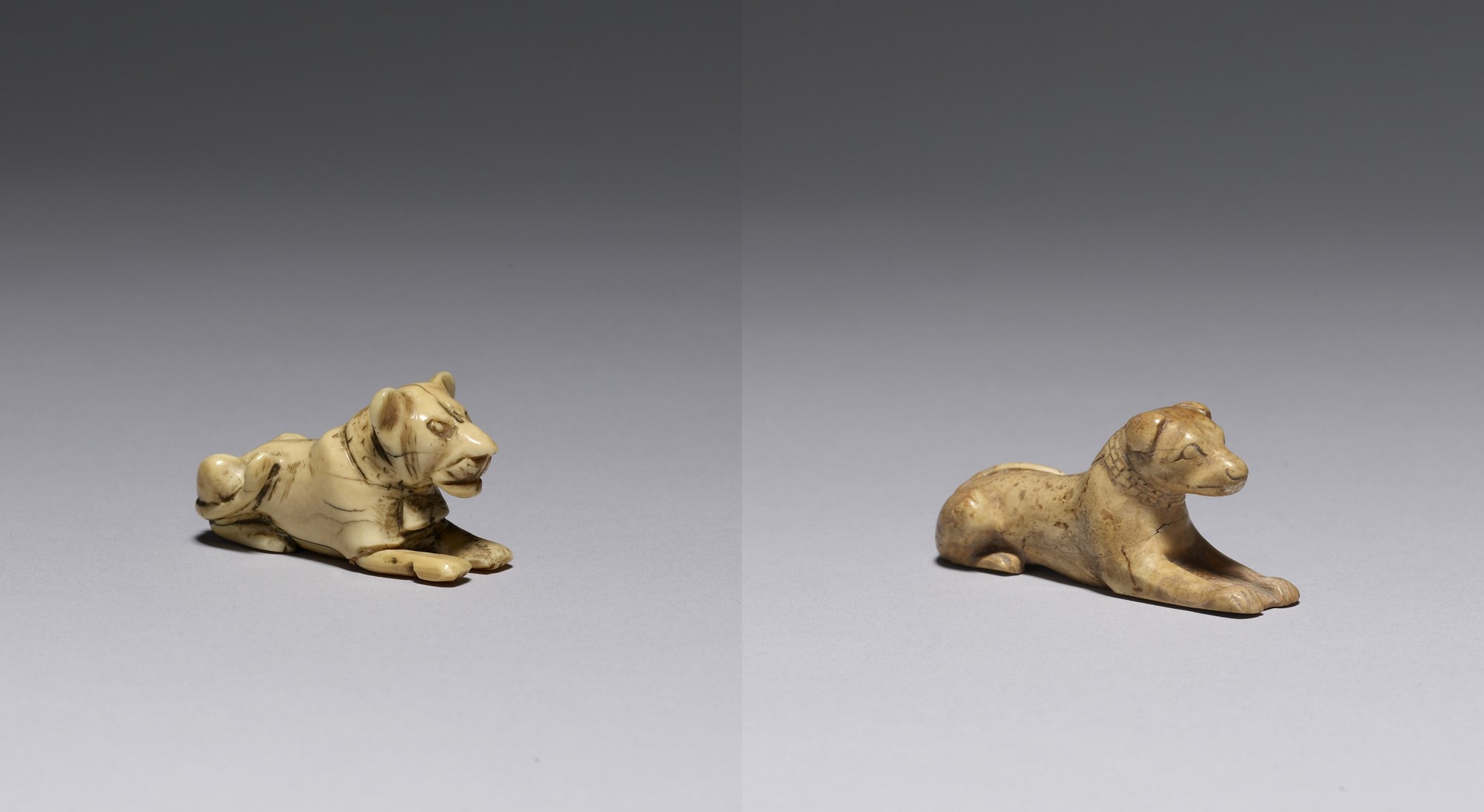








“Silver can buy many grains of salt.”
“Explain.”
“Money can be exchanged for goods and services.”
“Woohoo!”
In the Early Empire, the retirement bonus received by legionaries at the end of enlistment was a bonus equivalent to ~12 years pay, with your pay grade affecting that payment. Enough to buy a nice little farm in the provinces!