Explanation: Julius Caesar (of later dictator and conqueror fame, but at the time just an up-and-coming politician) was a reformist who was elected to the Consulship, the highest (two) office(s) of the Roman Republic, along with a decidedly conservative colleague, Bibulus.
Caesar crafted a piece of land reform legislature which removed all the stated reasons the conservative opposition offered for sinking prior land reform proposals, and ensured that it was high-profile enough that conservative leaders could not avoid addressing it. The ultraconservative Senator Cato the Younger, who hated Caesar’s guts, established the ‘party line’ of the conservatives - that it was a good piece of legislation (they could not deny that without sinking their own credibility) but that it was, in some vague way, the ‘wrong time’ for it.
This mealy-mouthed refusal was not enough to stop Caesar. Caesar, ever-the-showman, immediately set to pressuring his political foes with enthusiastic crowds - rather than seeking to intimidate them, he sought to make it impossible for them to refuse the demand of the crowds without appearing anti-democratic. Most significantly, he pressured his colleague, Bibulus, who had the power to effectively veto* legislation (as did Caesar) as one of the two consuls for the year. Bringing his colleague to the People’s Assembly, where the proposal would be voted on, Caesar addressed him amicably, offering him the platform to offer his reasoning for being against the bill. When his objections had little substance, Caesar led a crowd of Roman voters to cheer his name and beseech him to support their cause of land and bread for the poor citizens of Rome.
Bibulus refused several times, but eventually lost patience, and snapped at the crowd, “You shall not have [this legislation] even if all of you should want it!”
That was a bad response to a Roman crowd which still understood its political power. The mood turned very sour very quickly, and the crowd heaped invective and abuse upon Bibulus. Caesar made no effort to restrain the crowd at this point - in part because that would have damaged his image, and possibly in part because Caesar may have suspected Bibulus would have made such a blunder and desired the outcome. Bibulus would be thrown from the speaker’s platform, and the fasces (bundled sticks and axe) of his lictors (attendants) broken - a symbolic rejection of his magisterial power. The chaos would end with a chamber pot being emptied over Bibulus’s head by an upset voter.
For understandable reasons after that taste of what he could expect from Roman politics, Bibulus did not leave his house for the rest of the year (though he, unlawfully, attempted to veto all legislature without attending Senate meetings). This left Caesar as the only Consul who was actually in attendance during Senate meetings. The land reform bill would be passed shortly thereafter.
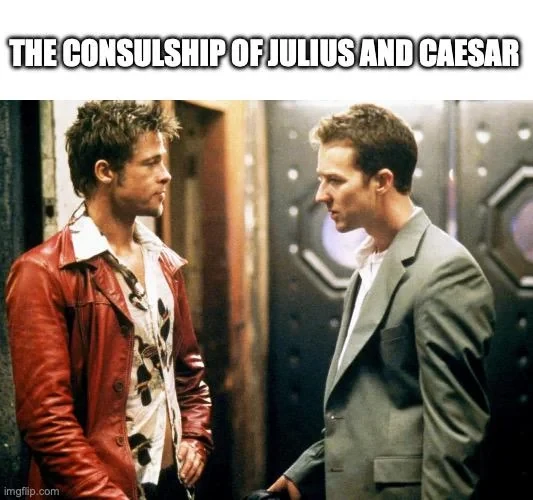
Since Roman years were traditionally named after the consuls elected in that year, the year became jokingly known as “The Consulship of Julius and Caesar” instead of “The Consulship of Bibulus and Caesar.”
*it was not a formal veto over legislature which the Consuls held, but the ability to declare ‘bad omens’, which was not supposed to be abused, but obviously was. Consuls could only formally veto each other’s actions. Formal legislative veto power was held by the People’s Tribunes - Republican Roman constitutional authority was all over the place


Explanation: Julius Caesar (of later dictator and conqueror fame, but at the time just an up-and-coming politician) was a reformist who was elected to the Consulship, the highest (two) office(s) of the Roman Republic, along with a decidedly conservative colleague, Bibulus.
Caesar crafted a piece of land reform legislature which removed all the stated reasons the conservative opposition offered for sinking prior land reform proposals, and ensured that it was high-profile enough that conservative leaders could not avoid addressing it. The ultraconservative Senator Cato the Younger, who hated Caesar’s guts, established the ‘party line’ of the conservatives - that it was a good piece of legislation (they could not deny that without sinking their own credibility) but that it was, in some vague way, the ‘wrong time’ for it.
This mealy-mouthed refusal was not enough to stop Caesar. Caesar, ever-the-showman, immediately set to pressuring his political foes with enthusiastic crowds - rather than seeking to intimidate them, he sought to make it impossible for them to refuse the demand of the crowds without appearing anti-democratic. Most significantly, he pressured his colleague, Bibulus, who had the power to effectively veto* legislation (as did Caesar) as one of the two consuls for the year. Bringing his colleague to the People’s Assembly, where the proposal would be voted on, Caesar addressed him amicably, offering him the platform to offer his reasoning for being against the bill. When his objections had little substance, Caesar led a crowd of Roman voters to cheer his name and beseech him to support their cause of land and bread for the poor citizens of Rome.
Bibulus refused several times, but eventually lost patience, and snapped at the crowd, “You shall not have [this legislation] even if all of you should want it!”
That was a bad response to a Roman crowd which still understood its political power. The mood turned very sour very quickly, and the crowd heaped invective and abuse upon Bibulus. Caesar made no effort to restrain the crowd at this point - in part because that would have damaged his image, and possibly in part because Caesar may have suspected Bibulus would have made such a blunder and desired the outcome. Bibulus would be thrown from the speaker’s platform, and the fasces (bundled sticks and axe) of his lictors (attendants) broken - a symbolic rejection of his magisterial power. The chaos would end with a chamber pot being emptied over Bibulus’s head by an upset voter.
For understandable reasons after that taste of what he could expect from Roman politics, Bibulus did not leave his house for the rest of the year (though he, unlawfully, attempted to veto all legislature without attending Senate meetings). This left Caesar as the only Consul who was actually in attendance during Senate meetings. The land reform bill would be passed shortly thereafter.
Since Roman years were traditionally named after the consuls elected in that year, the year became jokingly known as “The Consulship of Julius and Caesar” instead of “The Consulship of Bibulus and Caesar.”
*it was not a formal veto over legislature which the Consuls held, but the ability to declare ‘bad omens’, which was not supposed to be abused, but obviously was. Consuls could only formally veto each other’s actions. Formal legislative veto power was held by the People’s Tribunes - Republican Roman constitutional authority was all over the place
What a wall. I wasn’t expecting it.
Good read, but not sure how this relates to that movie.
The nomenclature for the years is based on the presumption that there are two people.
“The Consulship of Julius and Caesar” subverts that by using the two-person structure for a one-person occurrence.
In Fight Club, Tyler Durden and Jack are presented as two different people, but the climax of the movie reveals they’re actually only one.
Ohh, there it is. Thank you sir!
I think I see what I missed, edited to make it a little more clear.