
You must log in or # to comment.
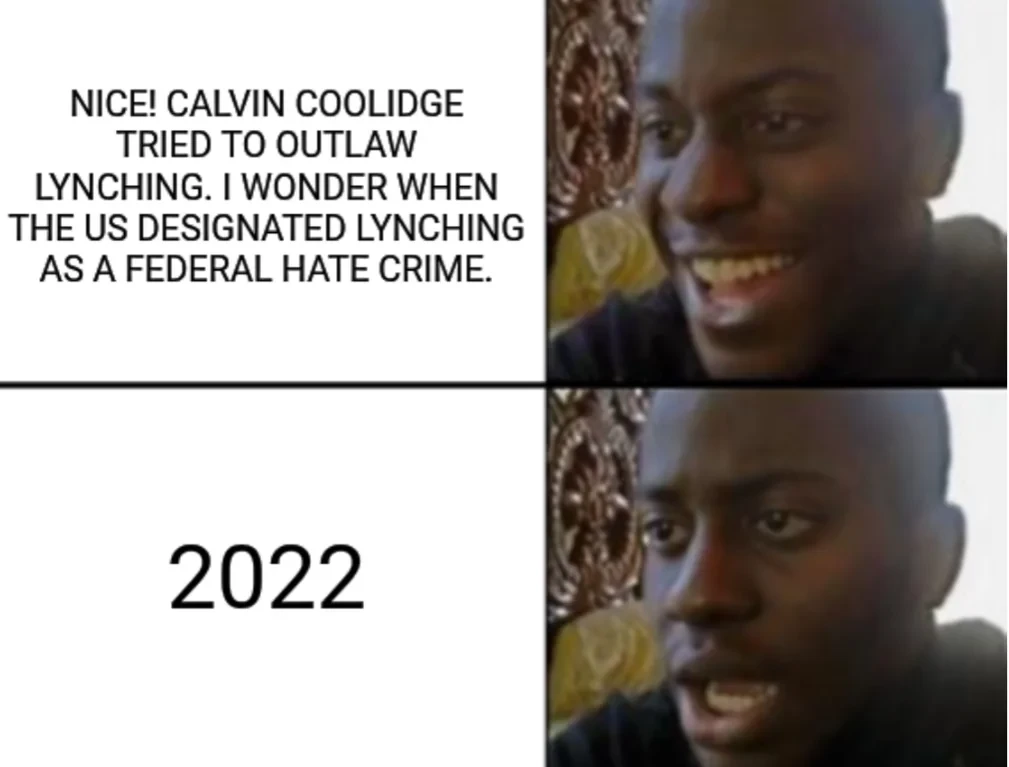
Explanation: The issue of making lynching an exceptional crime (rather than ‘just’ murder) subject to Federal investigation (and not local ‘good old boys’ covering it up) was a major issue in the early 1900s, with two attempts by Congress to pass anti-lynching bills, one in the 1920s and one in the 1930s. Both failed due to opposition from Senators from Southern states, predictably.
Notably, President Calvin Coolidge supported the anti-lynching bill in the 1920s despite generally having a very… restricted view of Federal power.
Symbolically, an anti-lynching bill was finally passed… in 2022, long after the most intense period of lynching had ended.
Like closing the barn door after the escaped horse has died of old age.
The term “hate crime” was essentially nonexistent until the 1980’s, and the first legislation to incorporate the term was passed in 1990. There are references to “hate crime” laws as far back as 1968, but they weren’t called that at the time. They were redefined as such after the term came into use some 20-odd years later. “Hate crime laws” weren’t an actual thing-- even simply in open discussion-- until the mid 80s/early 90s, with the major distinction being that crimes came with harsher penalties when they were prompted primarily by bigotry.
(EDIT) Fun fact: The Spanish Inquisition, that scourge of the Middle Ages with its torture chambers and burning of witches and Jews, wasn’t officially ended until 1834.