99% companies have been using Windows for the past 30 years. I would gladly accept any job using Windows, even more if they paid well. I hate Windows way more than everyone else, but being unemployed is worse nowadays.
You assume they don’t already have a job and we’re just looking for other opportunities. Not everyone is unemployed before they apply for other jobs. If anything that is a good time to look as it gives you stronger position to negotiate from.
In the overwhelming majority of situations you cannot begin the onboarding process with IT while still working for a previous employer. Especially at this level of software engineering that would run afoul of moonlighting policies.
is what your describing technically possible? sure. Is it even remotely probable? Absolutely not.
EDIT: I am absolutely flabbergasted at how many people don’t know their rights.
In the US this is covered by the Fair Labor Standards Act, which is extremely simple when defining what is considered on-the-job work. If it is mandatory, work-related, and for the benefit of the company, then it is on-the-job work and you should be paid for the time.
Stop perpetuating wage theft, people. It’s the #1 form of theft in the US by a wide margin. Learn your rights and demand pay for your work.
You are right. You cannot onboard a new job before you leave your old one. Accepting an offer is not part of the onboarding process though. It happens before.
After an interview process the company makes an offer. The candidate can then accept or reject it. But that is really all informal. You can then negotiate with them for an official start date and contract. You just need to ensure you can hand in your notice and work the rest of your notice period before the start date of your new contract.
I don’t know anyone that would hand in their notice before accepting the initial offer of a company. At least here in the UK.
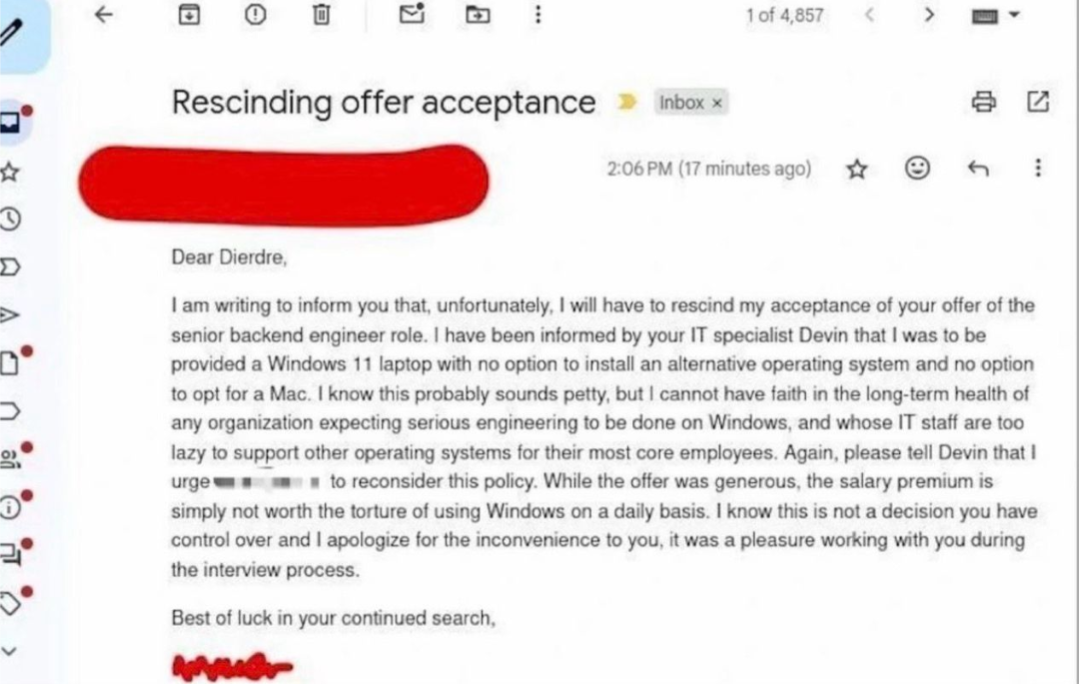
Communicating with IT is absolutely part of the onboarding process. And the phrasing of the email clearly states they are rescinding an offer acceptance, as in they had already accepted and begun onboarding.
You are not considered to be working somewhere until you have signed a contract and after the start date on that contract. Accepting a offer is not signing a contract. You are not working at the new place yet. You have no obligations to do anything at that point. You just need to have stopped working at your current employment before your start date. You definitely do not need to quit before accepting the offer. No where I have worked requires that.
I didn’t say you had to quit before accepting the offer. I said that the onboarding process itself is considered part of employment. If you’re talking to IT about setting up your workstation and not getting paid for it I feel bad that you’re being taken advantage of
EDIT: In the US this is covered by the Fair Labor Standards Act, which is extremely simple when defining what is considered on-the-job work. If it is mandatory, work-related, and for the benefit of the company, then it is on-the-job work and you should be paid for the time. So congratulations; you’ve likely participated in wage theft by onboarding people who aren’t being paid for their time. Obviously it wasn’t knowingly or with intent, but that doesn’t change the fact that, based on your response, your employers have had you or your coworkers participate in failing to pay people what they are owed.
Except for the other reply that starts “you are right. you cannot onboard a new job before you leave your old one”??? They may go on to say that accepting an offer isn’t onboarding but since I never tried to argue that it was, that’s kind of irrelevant.
Lots of people don’t know their rights or their obligations. Wage theft is the #1 from of theft in the US by a lot. Coordinating with an IT department for onboarding without getting paid for it is straight up wage theft and being taken advantage of. Doing so while still employed by another company is moonlighting under most contracts.
People do shit like that all the time. Doesn’t make it right. Doesn’t make it safe.
If you begin the onboarding process as a senior backend engineer without inquiring as to what your working environment will be, then you’re just incompetent.
If you’re talking to the IT department about workstation configuration without signing a contract and getting paid for it, you’re being taken advantage of.
Yes, it’s reasonable, and smart, to ask people during the interview process about their tech stack. But there is no way I’m coordinating with IT on the setup and configuration of my workstation without a contract in place or before my start date.
Yeah but a senior engineer would just use an old personal linux laptop from home, they wouldn’t even bother bitching about the employer issued machine.
Clients will have intellectual rights on anything produced for them. Removal of that data from their systems and storing it elsewhere will be a violation.
Using your own equipment other than maybe your monitor, mouse, or keyboard will be a no go. I don’t know of any serious workplace that would let you do otherwise.
Even if you are a self employed contractor you will need to remote in to their virtual environment and work in that.
Never, ever, EVER use your personal equipment for work.
There are a ton of legal reasons for that, not just around who owns the Copyright of work done on that machine as well as licensing of the software running in it (most commercial software has different licensing conditions for personal and commercial use) but also because if there’s some kind of legal case against that company your equipment might very well be confiscated as part of an investigation.
Also, more in general, if you have personal practices which are legally dubious or often frowned upon (piracy, porn) you don’t do it in the same machine where you’re doing your professional work, definitelly not on a work machine but even in your own machine it’s risky (see the point above about how your machine might end up confiscated and examined by the authorities if the company is investigated). The principle of “you don’t shit were you eat” applies here.
Even for your own company, it’s best to have the company stuff separate from personal stuff.
Beyond that, it’s also a very good idea in terms of having a good work-life balance to separate the personal from the professional: ideally you keep a very strong separation between work and not-work, at all levels, from work time and outside-work time to work/personal machine and work/personal phone - it helps make clear both for yourself and, even more importantly, others, that there is no work outside work, which reduces the chances of management doing things like call you on weekends or evenings with questions and makes it easier for them to accept when they try it and you say “I’m not at work now, so I’ll pick this up first thing when I’m back at work” - the cleaner and harder the split the less room there is for the “barely in control, almost 100% reactive” kind of manager to sneak work stuff into your personal-time.


99% companies have been using Windows for the past 30 years. I would gladly accept any job using Windows, even more if they paid well. I hate Windows way more than everyone else, but being unemployed is worse nowadays.
You assume they don’t already have a job and we’re just looking for other opportunities. Not everyone is unemployed before they apply for other jobs. If anything that is a good time to look as it gives you stronger position to negotiate from.
In the overwhelming majority of situations you cannot begin the onboarding process with IT while still working for a previous employer. Especially at this level of software engineering that would run afoul of moonlighting policies.
is what your describing technically possible? sure. Is it even remotely probable? Absolutely not.
EDIT: I am absolutely flabbergasted at how many people don’t know their rights.
In the US this is covered by the Fair Labor Standards Act, which is extremely simple when defining what is considered on-the-job work. If it is mandatory, work-related, and for the benefit of the company, then it is on-the-job work and you should be paid for the time.
Stop perpetuating wage theft, people. It’s the #1 form of theft in the US by a wide margin. Learn your rights and demand pay for your work.
They would quit working at the old company before they start work at the new one. usually there wouldn’t be overlap.
You are right. You cannot onboard a new job before you leave your old one. Accepting an offer is not part of the onboarding process though. It happens before.
After an interview process the company makes an offer. The candidate can then accept or reject it. But that is really all informal. You can then negotiate with them for an official start date and contract. You just need to ensure you can hand in your notice and work the rest of your notice period before the start date of your new contract.
I don’t know anyone that would hand in their notice before accepting the initial offer of a company. At least here in the UK.
Communicating with IT is absolutely part of the onboarding process. And the phrasing of the email clearly states they are rescinding an offer acceptance, as in they had already accepted and begun onboarding.
You are not considered to be working somewhere until you have signed a contract and after the start date on that contract. Accepting a offer is not signing a contract. You are not working at the new place yet. You have no obligations to do anything at that point. You just need to have stopped working at your current employment before your start date. You definitely do not need to quit before accepting the offer. No where I have worked requires that.
I didn’t say you had to quit before accepting the offer. I said that the onboarding process itself is considered part of employment. If you’re talking to IT about setting up your workstation and not getting paid for it I feel bad that you’re being taken advantage of
Is this some usa user who haven’t heard about other countries? (and I doubt it’s even true in the usa).
Not only is this definitely true in the US but I know it’s true in other countries like the UK and Japan as well.
Dawg put down the crack pipe you’re the only one who is asserting this.
Definitely NOT true in US, or UK. Didn’t work IT when I was in Japan so can’t say for that one, but likely not true there either.
EDIT: In the US this is covered by the Fair Labor Standards Act, which is extremely simple when defining what is considered on-the-job work. If it is mandatory, work-related, and for the benefit of the company, then it is on-the-job work and you should be paid for the time. So congratulations; you’ve likely participated in wage theft by onboarding people who aren’t being paid for their time. Obviously it wasn’t knowingly or with intent, but that doesn’t change the fact that, based on your response, your employers have had you or your coworkers participate in failing to pay people what they are owed.
Except for the other reply that starts “you are right. you cannot onboard a new job before you leave your old one”??? They may go on to say that accepting an offer isn’t onboarding but since I never tried to argue that it was, that’s kind of irrelevant.
Lots of people don’t know their rights or their obligations. Wage theft is the #1 from of theft in the US by a lot. Coordinating with an IT department for onboarding without getting paid for it is straight up wage theft and being taken advantage of. Doing so while still employed by another company is moonlighting under most contracts.
People do shit like that all the time. Doesn’t make it right. Doesn’t make it safe.
If you begin the onboarding process as a senior backend engineer without inquiring as to what your working environment will be, then you’re just incompetent.
If you’re talking to the IT department about workstation configuration without signing a contract and getting paid for it, you’re being taken advantage of.
Yes, it’s reasonable, and smart, to ask people during the interview process about their tech stack. But there is no way I’m coordinating with IT on the setup and configuration of my workstation without a contract in place or before my start date.
Senior backend engineering definitely doesn’t see 99% windows adoption rate.
Yeah but a senior engineer would just use an old personal linux laptop from home, they wouldn’t even bother bitching about the employer issued machine.
How are they going to use a personal device when corporate policy locks that down?
They don’t use a personal laptop, and I’ve never heard of such thing for any company that has more than 10 employees. The security risk is huge
Clients will have intellectual rights on anything produced for them. Removal of that data from their systems and storing it elsewhere will be a violation.
Using your own equipment other than maybe your monitor, mouse, or keyboard will be a no go. I don’t know of any serious workplace that would let you do otherwise.
Even if you are a self employed contractor you will need to remote in to their virtual environment and work in that.
Okay so remote in then idk how you accept a job and them giving you a windows laptop is a deal breaker
Never, ever, EVER use your personal equipment for work.
There are a ton of legal reasons for that, not just around who owns the Copyright of work done on that machine as well as licensing of the software running in it (most commercial software has different licensing conditions for personal and commercial use) but also because if there’s some kind of legal case against that company your equipment might very well be confiscated as part of an investigation.
Also, more in general, if you have personal practices which are legally dubious or often frowned upon (piracy, porn) you don’t do it in the same machine where you’re doing your professional work, definitelly not on a work machine but even in your own machine it’s risky (see the point above about how your machine might end up confiscated and examined by the authorities if the company is investigated). The principle of “you don’t shit were you eat” applies here.
Even for your own company, it’s best to have the company stuff separate from personal stuff.
Beyond that, it’s also a very good idea in terms of having a good work-life balance to separate the personal from the professional: ideally you keep a very strong separation between work and not-work, at all levels, from work time and outside-work time to work/personal machine and work/personal phone - it helps make clear both for yourself and, even more importantly, others, that there is no work outside work, which reduces the chances of management doing things like call you on weekends or evenings with questions and makes it easier for them to accept when they try it and you say “I’m not at work now, so I’ll pick this up first thing when I’m back at work” - the cleaner and harder the split the less room there is for the “barely in control, almost 100% reactive” kind of manager to sneak work stuff into your personal-time.
I mean yeah i wiped an old laptop and have that as a backup for work, don’t use it for anything else except when i don’t have the work laptop on me
deleted by creator