

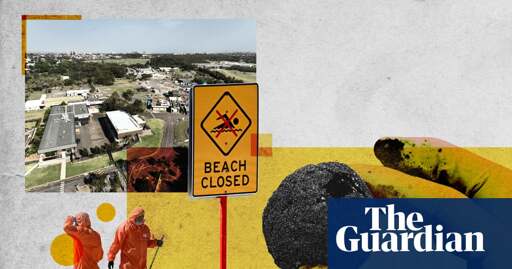
A giant fatberg, potentially the size of four Sydney buses, within Sydney Water’s Malabar deepwater ocean sewer has been identified as the likely source of the debris balls that washed up on Sydney beaches a year ago.
Sydney Water isn’t sure exactly how big the fatberg is because it can’t easily access where it has accumulated.
Fixing the problem would require shutting down the outfall – which reaches 2.3km offshore – for maintenance and diverting sewage to “cliff face discharge”, which would close Sydney’s beaches “for months”, a secret report obtained by Guardian Australia states.
“The working hypothesis is FOG [fats, oils and grease] accumulation in an inaccessible dead zone between the Malabar bulkhead door and the decline tunnel has potentially led to sloughing events, releasing debris balls,” the report concludes.
“This chamber was not designed for routine maintenance and can only be accessed by taking the DOOF offline and diverting effluent to the cliff face for an extended period (months), which would close Sydney beaches.”
A modern western city that dumps fucking raw sewage directly into the ocean. Embarrassing.
Yeah. We are an arrogant, fucked up species.
I did a sewage treatment plant tour in my high school biology class. At the end of the second stage filtration, the worker pointed at how it discharges into the ocean.
“So at this point, the water has been treated enough that it’s safe to drink”
We all scrunched our faces at that. Then he added
“But I wouldn’t”
You would be amazed how often “the solution to pollution is dilution”. Can’t dump that raw chemical into the water/sewer, oh no. But if you dilute it with 5000 gallons of water? Oh well now it’s at “acceptable levels”. Notice how most regulations talk about “parts per million”(PPM). Well, it turns out that when most of your regulations are written such that you only have to “properly dispose” of something if it’s above a certain concentration, you can just dilute it below that level and BAM, “safe to dispose of”.
Nice that the article is trying to make it sound like such solutions are from ‘other countries’
Meanwhile, we have full treatment in South Australia and the outflow water is used for watering gardens.
As a fellow South Australian, I had the same thought. This is NOT an Australian issue, this is a Sydney issue.
‘Sydney is a hole’ is factually accurate.
Facturate. We should coin that term for when something is extra accurate.
This is highly misleading. Even if you can get drinking water out of sewage, most of it is disposed somewhere. Sidney might be doing a shit (pun intended) process, but there’s no magic way too turn it all into water.
Wichita Falls, Texas actually piped their treated sewage outflow directly into their treatment plants for a short while because if a drought. Usually it gets dumped in a river after treatment but they were running out of water.
https://practical.engineering/blog/2025/6/17/how-sewage-recycling-works
This is the second interesting thing I’ve read about Wichita Falls (there aren’t many). The other is that it’s the home of the “World’s littlest Skyscraper”. Last I checked there was a furniture store there.
Edit: I dropped this]
That’s the kinda stuff I enjoy reading, thank you for sharing.
Vienna, too, is known for its pure waste water. The output into the Danube river is tap water quality.
Citation needed.
I highly doubt that. There would be absolutely no reason to clean the water up to tap water quality and then discharge it into the river, instead of using it as tap water. That’s just not economically feasible.
I know a part of the Danube near Vienna is a valuable nature reserve, but even then tap water quality is not necessary.
If you have a source that proves your claim, I’d be highly interested to learn why and how they do that. I have a degree in environmental engineering, and I want to know when I’m wrong about something like this.
Not my circus or my monkeys, but I can’t sleep so I did some cursory searching. I did undergrad research that was heavy into wastewater treatment, so this did sound a bit unlikely.
I found the biological secondary is pretty extensive and is being well utilized for energy generation, so the resultant level of treatment makes more sense. It looks like the claim is closer to “you could drink it if you wanted to, but don’t”.
https://envsci.ceu.edu/article/2025-02-27/turning-waste-power-visit-viennas-wastewater-treatment-plant
https://www.wte.de/en/references/wastewater-treatment-vienna-austria/
And that’s partly my point.
“Safe to drink” means: you can drink this and not immediately die or get sick/poisoned from it.
“Drinking water quality” means: if you drink nothing but this water for your whole life, it won’t harm you. (as far as our scientific understanding goes)
That’s a bit of a gap.
this is much more common than you think
I’m hoping it’s not RAW sewage
It is. Sydney only does “primary treatment” which is literally running it through a strainer to separate the big chunks, and then they just dump it.
JPEG sewage
This compression is shit.