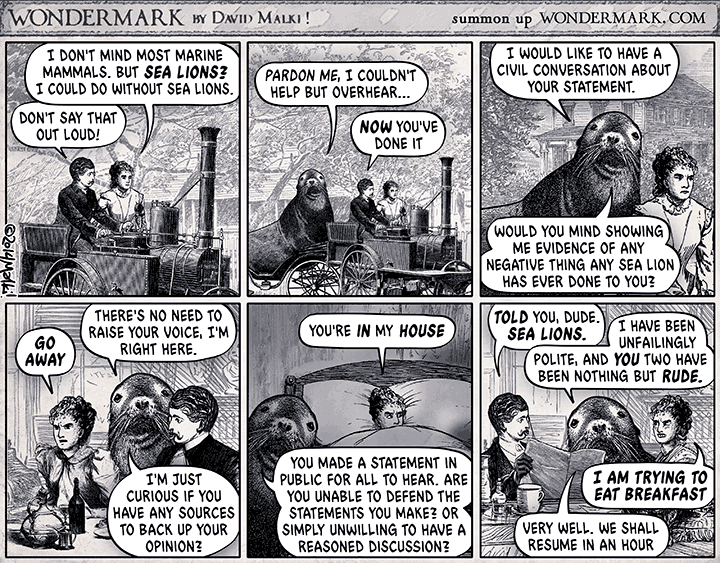
It’s a clever method of trolling. But if you come prepared and/or are willing to put some effort in, you actually can wreck them with evidence and sound arguments that shuts them completely up.
This is very satisfying.
It’s also frustrating because there are people who are sincerely trying to discuss in good faith while having a different opinion, which is camouflage for the sealion trolls.
Of course, people increasingly forget about the former group completely, and react with hostility… It’s understandable, but unfortunate for healthy discussion.
At least in your case, your response is to lay out robust arguments to explain your position, which is productive regardless of whether they’re trolling or sincere. I’ve learned a great deal over the years from strangers on the internet putting a clinic on someone who may or may not have been trolling.
Accusing people of “sealioning” is a great way to not have to defend or discuss poorly thought out or sourced claims.
This is why we need seal clubbing
Pardon me, I couldn’t help but overhear…
Would you mind showing me evidence of any negative thing any sea lion has ever done to you?
I’m just curious if you have any sources to back up your opinion that seal lions need clubbing.
I don’t know. They stay out too late, get way too drunk and make a terrible racket when they get home.
Other related argument techniques used on the internet (and elsewhere) often commingled with Sealioning:
Butwhataboutism is a pejorative for the strategy of responding to an accusation with a counter-accusation instead of a defense of the original accusation.
Also, ignoring the rebuttal and constantly shifting the attack to a tangentially related part of the discussion forcing the opponent to defend and rebut each new point, generally exhausting them and causing frustration and irritation.
JAQing off is a way of attempting to make wild accusations acceptable (and hopefully not legally actionable) by framing them as questions rather than statements.
Moving the Goalposts in which evidence presented in response to a specific claim is dismissed and some other (often greater) evidence is demanded. Closely related to butwhataboutism.
Appeal to Hypocrisy (tu quoque) basically tries to invalidate your opponent’s argument by using a “your side did it too, worse” and shift the argument to them defending themselves.
And don’t forget the good old ad hominem, where instead of addressing any points, it attacks the one who made it in an attempt to intimidate the one making the point and applying peer pressure on others reading it to keep them away from that position.
Had someone use that on me earlier today lol. They aren’t particularly effective on Lemmy, I’ve noticed. On Reddit, it depended on if they are for or against the popular circle jerk.
Important detail, regarding argumentum ad hominem (AAH): a lot of people incorrectly conflate the fallacy with insults, even if both things are independent. For example, let’s say that someone said “the Moon is made of green cheese”. Here are four possible answers:
Replies With insult Without insult With AAH You’re a bloody muppet, thus the Moon is made of rocks and dust. You’re no astronomer, thus the Moon is made of rocks and dust. Without AAH Yeah, because there’s totally cheese orbiting Earth for a bazillion years, right? Bloody muppet. Cheese wouldn’t be orbiting Earth for so long without spoiling. This conflation between ad hominem and insults interacts really funny with sealioning. Sometimes you get the sea lion claiming that you’re using AAH because you lost patience with its stupidity, but they’re also prone to use non-insulting AAH.
The insults never add anything useful to arguments and still appeal to the same basic things as insults alone, even if they are accompanied by logically sound arguments. And while they don’t logically weaken a position, they can emotionally weaken it for those who recognize frustration reactions as a sign of weakness.
Rage and anger might feel powerful, but they actually betray a sense of a lack of control. Trolls take advantage of this because it’s a sign they are getting to you. Plus it’s rare that people respond to insults by agreeing with the one who insulted them and the times when they do usually involve an appeal to authority (where the insulter has authority to back up their position and challenging them can have consequences).