

You must log in or # to comment.
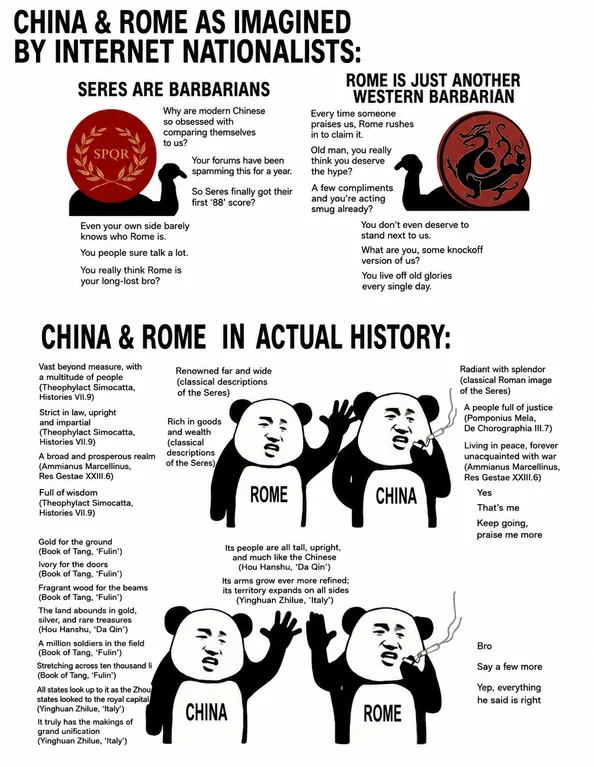
Explanation: Sometimes dickwaving nationalists online get into fights about whose polity was better in a given period, because that’s important for their self-identity or somesuch.
Of course, the Roman Empire is ALWAYS the best Empire REGARDLESS of time period OR your national originAs both Han Dynasty China and the Roman Empire (at least, the Principate) were roughly contemporary with one another, they’re a relatively common matchup, and can involve both sides slinging mud at each other - sometimes in good fun (usually not nationalists), other times much more seriously (more often nationalists of some variety or other).
However, while both Rome and Han China had only a vague idea of the other, they both regarded the opposite polity as some imposing, distant, magnificent realm, not a place to be derided or disregarded. The massive Persian Empire between the two polities prevented most direct exchange (one presumes Persia keeping control of those precious trade routes was more important to the Persian Empire than Roman/Chinese academics being able to sate their curiosity freely), but the two still did their best to form an idea of what the far-off country on the other side of the world was.
While there were definite and major misconceptions on both sides, in the grand tradition of “We don’t know about this particular detail, so we’re just going to make shit up” commonly featured in pre-modern authors, they both featured are a number of relatively accurate estimations by Han and Roman writers about their opposites - in almost all cases, both considered the other Empire to be grand and advanced, a sort of mirror-civilization rather than just distant barbarians. Both agreed the other polity was vast, respected, and rich.
Notably in emphasis, Roman writings poured over the supposed knowledge and wisdom of the Chinese (“Seres”) - not necessarily unwarranted, considering that the Confucian bureaucracy of that time predicated positions of power on academic learning - a far cry from the Roman system, which was (depending on position) either based on nepotism or a popularity contest! They also saw the Chinese system, even at a distance, as being ‘just’ - while we might dispute that (and the Roman system too, for that matter) in the modern day, the clear codification of law and authority would have been appropriately ‘just’ to Roman eyes - or Roman ears, even relayed over several games of whisper! Likewise, the Roman recognized that China was in some vague sense more ‘settled’ than their own Imperium Sine Fine (“Empire without end”), ruling over the territory it wished to, and as such being primarily ‘at peace’ (please ignore the barbarians at the doors and the internal revolts).
The Han (and later Tang, referencing in part the Byzantines), likewise, recognized that Rome (and the later Byzantine Empire) was expansionist, adaptive, and militaristic, even through the great distance they had to acquire their information from.
… if memory serves, note is also made in Chinese records over the supposed good looks of the Roman people and their leadership. One presumes this is the aesthetic emphasis of Graeco-Roman artwork (including coinage) which would have seen occasional import into China, or else just a “grass is greener on the other side” moment, especially since, as mentioned, direct contact was near-unheard of.
A semi-official embassy may have been sent/arrived in China in the late 2nd century AD - unfortunately, around that time, the Han Dynasty was falling apart, and the Roman Empire was about to enter a period of crisis. Who knows what extra tidbits of rumor could’ve been passed along and recorded for our enjoyment with a few more decades of stability on both sides!