They did, but generally they were considered undesirable. Only a force with an overwhelming advantage or a need to force a quick resolution of the war (in medieval Europe, at least) would typically attempt to engage an enemy in a field battle. In most situations, it would be down to besieging and taking the disputed location (war, politics by other means, etc) or doing the same to an enemy’s holdings one-by-one to force them to the negotiating table before you ran out of money with which to pay your long-term mercenaries. The attacker generally did not want a high-casualty and uncertain field battle which would be costly and reduce their chances of success next siege, and the defender likewise generally did not see the point in sacrificing the defensive advantage when time was their greatest ally on campaigns, considering organizational and logistical constraints of medieval armies.
Admittedly, sieges were usually a matter of weeks rather than years. But memes are allowed a little exaggeration - as a treat!
Contrast this to the Early Modern Period, in which sides would sometimes even agree on a battlefield to cut the bullshit to a minimum; or the Classical period, in which several days of ‘offering’ and denying battle from opposing fortified camps were often engaged in on each field until one was found that both sides thought they had the advantage on (or could not beg off battle any longer for reasons of supply).


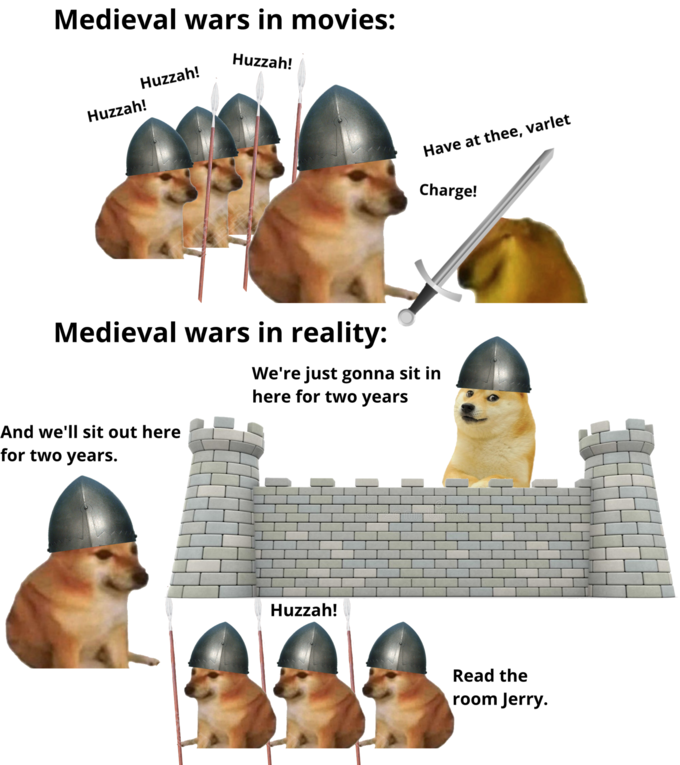
They did, but generally they were considered undesirable. Only a force with an overwhelming advantage or a need to force a quick resolution of the war (in medieval Europe, at least) would typically attempt to engage an enemy in a field battle. In most situations, it would be down to besieging and taking the disputed location (war, politics by other means, etc) or doing the same to an enemy’s holdings one-by-one to force them to the negotiating table before you ran out of money with which to pay your long-term mercenaries. The attacker generally did not want a high-casualty and uncertain field battle which would be costly and reduce their chances of success next siege, and the defender likewise generally did not see the point in sacrificing the defensive advantage when time was their greatest ally on campaigns, considering organizational and logistical constraints of medieval armies.
Admittedly, sieges were usually a matter of weeks rather than years. But memes are allowed a little exaggeration - as a treat!
Contrast this to the Early Modern Period, in which sides would sometimes even agree on a battlefield to cut the bullshit to a minimum; or the Classical period, in which several days of ‘offering’ and denying battle from opposing fortified camps were often engaged in on each field until one was found that both sides thought they had the advantage on (or could not beg off battle any longer for reasons of supply).