
You must log in or # to comment.
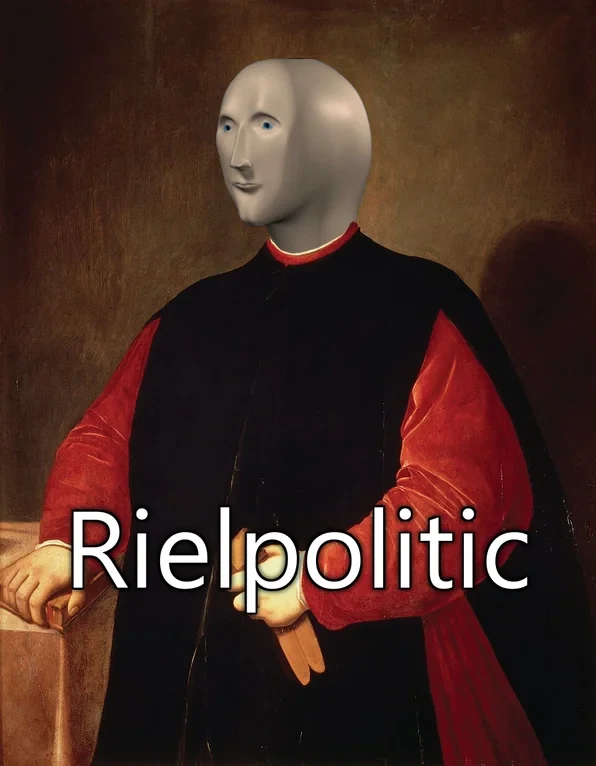
Explanation: Depicted (sans the actual head) is the Renaissance-era Italian Niccolo Machiavelli, the author of The Prince, often considered a foundation work for the idea of realpolitik (a German word, ironically). In The Prince, Machiavelli advises that an autocrat must act purely rationally and amorally in order to maintain their rule and their polity’s stability. The Prince was not published until after Machiavelli’s death, and was not his focus during life - but it’s what everyone knows him for in the modern day.
Some say that The Prince is meant as sarcasm rather the sincerity, but I don’t agree. I think it is sincere - but with the understanding that Machiavelli was a strong supporter of republics over autocracies. In that sense, it reads as “An autocrat is in a terrible position, but if there is an autocrat, this is the rational way to hold power.”
And it is, genuinely, amoral advice rather than immoral. Machiavelli advocates in The Prince for both altruism and ruthlessness, but always, always picked for their effect on stability and politiking, not morality.
Interestingly enough, in his other works, Machiavelli is somewhat more idealistic when talking about his favorite subject (REPUBLICS), suggesting that The Prince is not meant as a universal guide but as a specific demonstration of autocratic or near-autocratic authority’s optimal behavior. He also lived in Italy at a point in time when everything was falling to shit (but beautifully, because it was the Renaissance), so some of it may also have been “Che cazzo! If you’re going to be brutal autocrats, at least stop dismantling Italy’s future as you rule!” (Machiavelli was an early nationalist who dreamed of a united Italy, in the spirit of the Roman Republic which he adored)
Referenced in the title is a famous quote from The Prince, that if one must do harm to someone, one must be certain to do so much harm that you don’t need to fear the possibility of revenge. Half-measures just make fierce enemies!
Also Riel