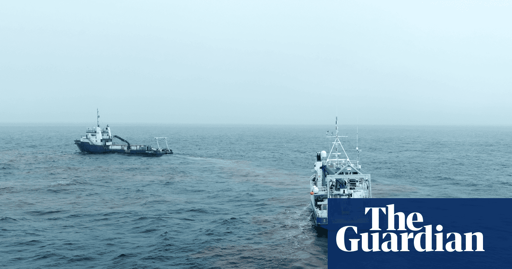
For four days last August, a thick slick of maroon bruised the waters of the Gulf of Maine. The scene, not unlike a toxic red tide, was the result of 65,000 litres of an alkaline chemical, tagged with a red dye, that had been deliberately pumped by scientists into the ocean.
Though it sounds perverse, the event was part of a scientific experiment that could advance a technology to combat both global heating and ocean acidification. Ocean alkalinity enhancement (OAE), as the approach is called, acts like natural weathering, but on human – rather than geological – timescales.
“The ocean is already incredibly alkaline. [It holds] 38,000bn tonnes of carbon, stored as dissolved bicarbonate, or baking soda,” says Adam Subhas, the lead oceanographer of the research team who announced early results from their test at the AGU Ocean Sciences Meeting in Glasgow.
Boosting this natural alkalinity using a chemical antacid should, in theory, encourage the ocean to absorb more carbon. Over a large surface area, and in combination with sharp emissions reductions, OAE could prevent global temperatures exceeding 2C above preindustrial levels, while locally reducing ocean acidity, which is now higher than at any point in the past million years and poses a dire threat to marine life and fisheries.
How about we stop producing more carbondioxid instead of finding new creative ways to deal with it? No? OK, carry on then.
New creative, expensive, experimental ways. So stupid.
Quite skeptical of solutions that don’t involve just leaving the environment be and letting natural processes play out. Like trying to keep a forest healthy by “controlled” burning/logging, clearing downed trees as if they were human trash instead of newly fallen habitats for myriad species of life, distributing nutrients into the soil at a pace that seems slow to us but perhaps necessary to who-knows-how-many species.
The idea that we can affect nature on a human-rather-than-geological timescale is true. The idea that we could bring a particular ecosystem from collapse into balance on a human timescale, with rudimentary human interventions, is full of hubris and folly. They’re intricate systems in which innumerable species have co-evolved over millions and millions of years. We all know about the butterfly effect. Many of us have read A Sound of Thunder. How about Frankenstein? Icarus? We ostensibly know the lessons. When will we finally change our actions to be in line with what we are – a small component of a global ecosystem – instead of masters over it?
Yes it can. First you pump the sea full of the most obnoxious, toxic, lethal poison, then you wait for the global food web to collapse, taking humans with it.
Climate will begin to behave within a few hundred years.
the most obnoxious, toxic, lethal poison
/yeets billionaires into the sea
Have people not seen Snowpiercer?
Are you not aware that Snowpiercer is fiction?