

If you’re anything like my parents, you probably wouldn’t even understand most of the content that floods my social media, no matter how hard I try to avoid it.
Here’s a recent example from Instagram: “Do y’all females ever tell ur homegirls ‘Sis chill you letting too many dudes hit?’” Essentially, that means: “Women – do you ever tell your girlfriends that they’re whores and need to stop letting so many guys fuck them?” The reel, posted by a 19-year-old man, appeared on my Instagram feed without me wanting to see it, or ever interacting with any other similar content. The comments that followed were pure misogyny. “Women see body count as a leaderboard and they try to outdo each other,” was one of them. Translation: all women are competitively promiscuous.
Consider the use of the word “female” in these posts. It is not a neutral term here, it is a term of abuse. It’s used by teenage boys to degrade us and equate us to animals. Boys are never described as “males”, but girls are always “females” – the equivalent of sows or calves, creatures that are less than human. We’re also “thots” (whores), “community pussy” and “bops”. “Bop” stands for “been over passed” and is a derogatory term used by boys to refer to a girl they’ve decided has been “passed around” or had too much sex. Sexual equality has ceased to exist online. It’s absolutely fine for boys to have sex, but when girls do, they are called worthless and referred to as objects. “When community pussy tries to insult me, I just want to beat that bitch up.” That’s a message I saw on TikTok.
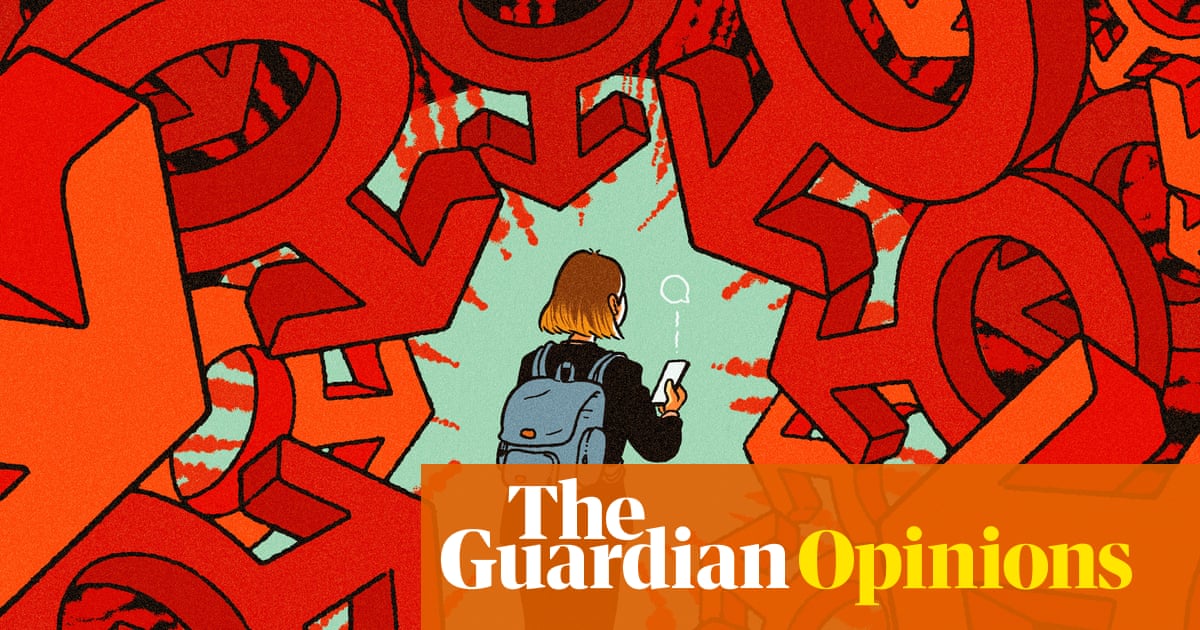
I’m a 15-year-old schoolgirl and like most teenagers I spend a fair portion of my spare time on social media, often scrolling through short-form videos on apps such as Instagram or TikTok. All of my friends use those apps, and many spend multiple hours a day on them. I actively try to avoid online misogyny, but I am met with it incessantly whenever I open my mainstream social media apps. It only takes a few minutes before there’s subtle or overt misogyny, such as comment sections on a girl’s post filled with remarks about her body, videos made by men or boys captioned with a degrading joke, and even topics such as domestic violence or rape, trivialised and laughed about.
I keep falling into the same trap as well, when telling people I quit using “social media” but am very much active on social media platforms - just not the ones controlled by big tech.
Maybe we need a shorthand for “profit-driven algorithm-controlled influencer cesspools” so we can separate it from “non-profit decentralized social media platforms” like Lemmy and Mastodon?
It’s called the Social Graph. Platforms that implement a social graph are social media.
The fact that people don’t know this basic, fundamental mechanism is the problem. Even the technologically inclined haven’t been able to make this simple distinction.
People think “social media” means a place for people to be social. That’s not it. Social media is specifically platforms that implement the social graph and/or similar types of algorithms that are designed to manipulate sociological relationships.
Traditional message boards are not social media because there is no algorithm. In the past reddit wasn’t social media because it technically did not have a social graph. It was a simple aggregrator with comment sections. That alone does not make social media. reddit does have a social graph now. That’s when it became social media.
Lemmy doesn’t have social graph algorithms.
The social graph is quite possibly one of the most dangerous inventions the 21st century and nobody talks about it. Yet it rules your entire life. It’s what makes the world turn. It’s what is dictating cultures and societies. It’s what is determining what goes viral. It determines the daily headlines.
Hey thank you for the term drop! I haven’t heard of “social graph” and it falls into my “feelings” of what social media has been for me(or what I hate about it(algorithms)). I am definitely a “one in ten thousand” today for this.
While I completely agree with you on all arguments about the dangers of algorithm-based platforms where eyeball count and time spent in apps (ad revenue) are the primary reasons behind their very existence, I disagree on your definition for the term social media.
I tried to find some sources for your definition, but for example the Wikipedia article on social graphs define Facebook as an online social network (although it also calls it a social media platform).
Judging by the list of social networking services, the definition (at least on Wikipedia) seems to lean towards “any site where you can add people as friends” (thus building the social graph you refer to).
Personally, I think that term fits better with your description (platforms based entirely on a social graph), while online social media is a broader term describing any online medium on which we socialize with other people - graph-based or not. Old-school forums and chat rooms included, even if we didn’t call them that back then.
Maybe, but I’ve definitely seen people disagree about what constitutes social media - e.g. some thing youtube is or isn’t, other people lemmy/reddit are or aren’t, it seems pretty inconsistent. Maybe it’s a generational thing?
In this sense, yes to Reddit and YouTube. YouTube may not be very social but it clearly has an algorithm that pushes toxic content/stereotypes.
And im going to say no on Lemmy. Lemmy may be social but there’s no algorithm pushing toxic content. Maybe I’m missing it but there’s seems to be very little toxic content.
You’re saying the criteria for being called “social media” include, “must be toxic” and “must be algorithmically-driven”?
Maybe this is an age thing and language has changed (I’m old in Internet years) but to me, “social” implies the opposite of those things - friendly interaction and organic connection.
I’m saying the term is somewhat nebulous, with lots of gray area but also an objective definition would not answer the question.
People do disagree on what constitutes social media, and even apply it inconsistently to themselves. So let’s not pretend there is a clear definition. Language isn’t always cleanly defined so we can understand what “social media” is based on context