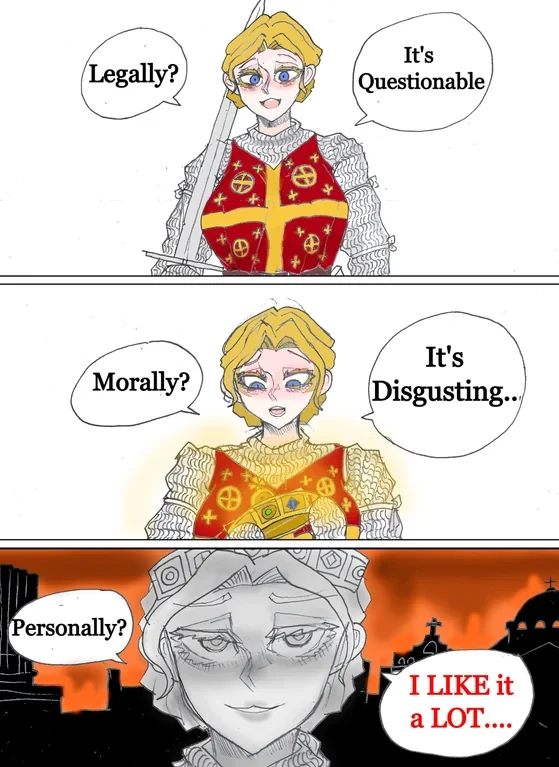

Explanation: In the medieval period, a series of wars known as the “Crusades” were undertaken by Catholic Christians from Western Europe, nominally in support of the Orthodox Christians of the Byzantine Empire, roughly modern day Greece and Turkiye. The goal of these expeditions was to reclaim the “Holy Land”, a subsection of the Levant important to Christianity, from Muslims.
During the utterly botched Fourth Crusade, which ran into numerous other mishaps and misadventures along the way, a significant body of the crusaders not only utterly failed to engage their nominal Muslim enemies, but they also warred on, besieged, overthrew, and conquered the Byzantines. This despite the Pope explicitly forbidding them from warring on any Christian polities.
But hey! Loot, land, and power! What’s not to like?
Was this the one where Venetian traders were like, “we’ll happily take you from Italy to the Holy Land, we just need you to stop off and take care of some competition that has been bothering us along the way,” and that “competition” turned out to be Constantinople?
First stop was Hungary, but yes.
The crusaders incurred a huge debt contracting with the Venetians, and when the lackluster crusade didn’t turn up enough people (rich OR poor) to fund the full debt for the transport fleet (which was much larger than it needed to be, since they were expected a larger turnout for the crusade), there was a ‘no refunds’ policy taken by Venice. Venice demanded payment in other forms - first to subdue some local Christian cities they regarded as ‘rightfully’ Venice’s.
After that, the crusaders were still short on cash and running low on supplies, as the strongarming was only to cover the remainder of the contract that they couldn’t afford, and the contract’s duration for providing supplies to the crusaders was running low - in large part because of the time taken by the strongarming detour. They could have disembarked as-planned, but would have done so with almost no food deep in hostile territory, which was not the original plan - hardly an auspicious start to a ‘successful’ crusade. The deposed Byzantine Emperor contacted part of the crusade and offered to pay off their whole debt to the Venetians and provide troops and support to the Holy Land if they put him back on the throne. The Venetians, seeing a chance to fuck over the Byzantines, their traditional enemies, were strongly in favor of the plan.
Of course, this ran into one small problem - the Byzantine Empire was in no shape to pay off massive debts or provide large armies to military adventures at this time. It was only barely holding itself together. When the crusaders sacked Constantinople and put the previous Byzantine Emperor on the throne, they found out that his promises were largely empty, and that even the entire Byzantine treasury couldn’t pay what they were promised.
… so they couped (and killed) the Emperor they themselves had installed by coup, and instead founded what is usually referred to as the “Latin Empire” in modern histories, a Catholic crusader state which ruled over Constantinople and the surrounding area, with only the fringes of the Byzantine Empire remaining free from Catholic control. This section of the crusade never did actually tangle with the Muslims, and the section of the crusade that DID reach the Holy Land (largely made of crusaders who refused to do either sack, Hungary or Byzantine) disbanded because they were too few by that point to convince the local crusader states to start another war with the Muslim polities.
The Pope was reportedly legitimately unhappy about every part of this.