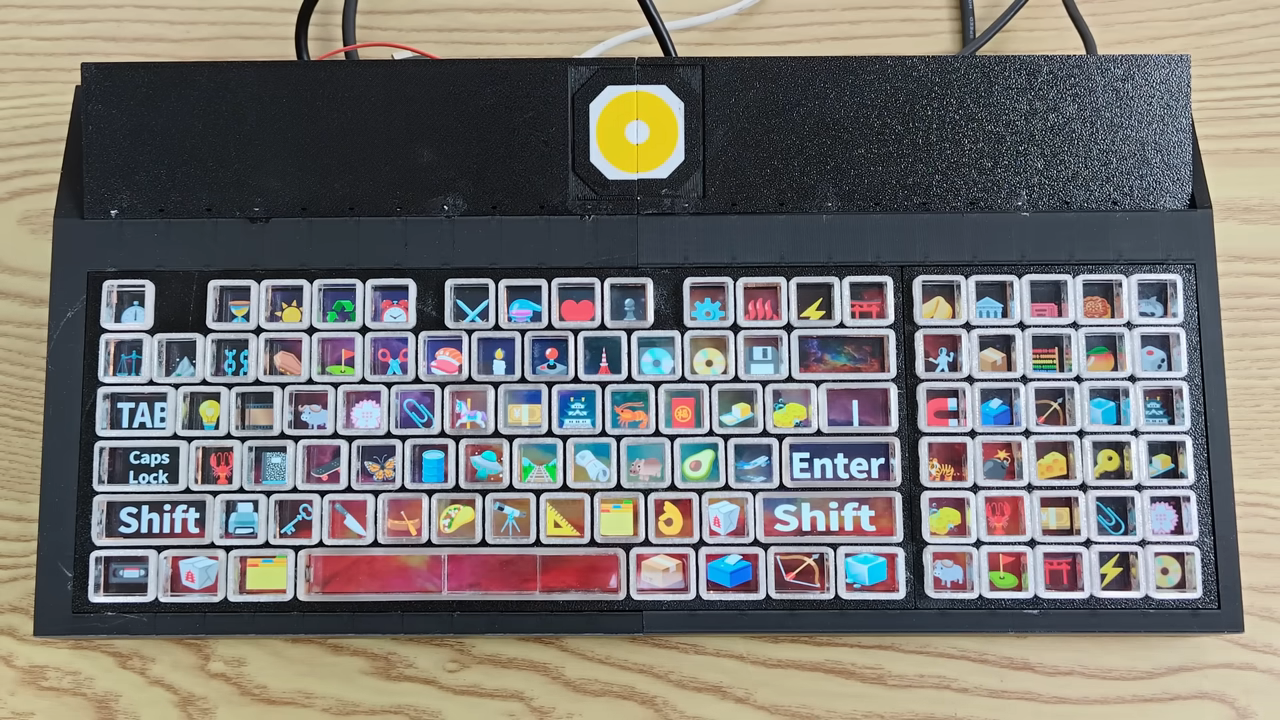
Most keyboards are factory-set for a specific layout, and most users never change from the standard layout for their home locale. As a multilingual person, [Inkbox] wanted a more flexible keyboard.…
If there were cheap, open source, resin 3d printers with an open slicer, I would be tempted to design a keyboard that uses light pipes and 2-4 LEDs per key to make something like this. Many early electronic display devices worked like this. Like some of the early Apollo program hardware NASA used were just little incandescent bulbs barely more than a Christmas lights. These were angled and projected onto a plastic lens with specially angled facets on the back that created a pathway for one of eight bulbs to create a numerical display. Fran’s Lab on YT tends to show off stuff like this. It should be possible to make a similar light pipe design for multiple key backlights.
I would probably get too side tracked in making printable mechanical keys.


If there were cheap, open source, resin 3d printers with an open slicer, I would be tempted to design a keyboard that uses light pipes and 2-4 LEDs per key to make something like this. Many early electronic display devices worked like this. Like some of the early Apollo program hardware NASA used were just little incandescent bulbs barely more than a Christmas lights. These were angled and projected onto a plastic lens with specially angled facets on the back that created a pathway for one of eight bulbs to create a numerical display. Fran’s Lab on YT tends to show off stuff like this. It should be possible to make a similar light pipe design for multiple key backlights.
I would probably get too side tracked in making printable mechanical keys.
If you can do basic wiring and some light soldering there is https://www.nano3dtech.com/